Regulatory Brief
DJI AP100 Parachute in Canada: Flying Over People Rules
The DJI AP100 parachute for Matrice 400 meets EU C5/C6 rules — but not Transport Canada's over-people requirements yet. What Canadian operators must know.
Remote Robotic · July 8, 2026 · 9 min read
Last verified against Transport Canada's declared-drones list: July 2026.

What Is the DJI AP100 Parachute?
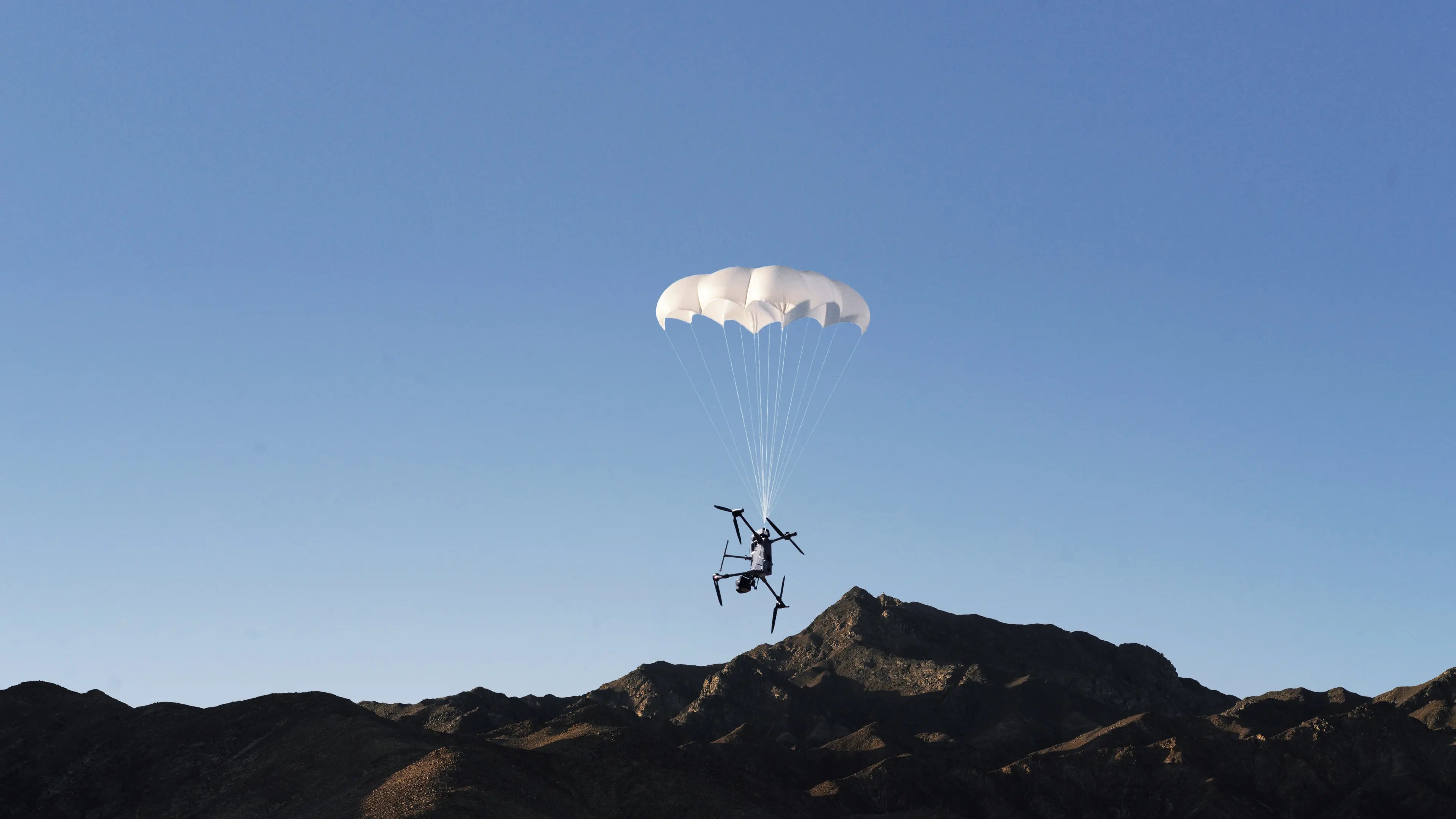
The DJI AP100 is a deployable parachute recovery system built specifically for the DJI Matrice 400. DJI positions it as protection for "the priceless below" — the aircraft, its payloads, and the people and property under the flight path. If the aircraft suffers a critical failure in flight, the AP100 stops the rotors and deploys a canopy to bring the drone down slowly instead of in an uncontrolled descent.
For Canadian public safety and industrial operators, that matters because ground risk — the injury potential of an aircraft coming down on someone — is exactly what Transport Canada's rules for flying near and over people are designed to manage.
DJI AP100 Key Specifications
| Specification | DJI's published figure |
|---|---|
| Automatic deployment response time | ≤600 ms (FTS trigger → rotor stop → gas generator fires) |
| Stabilized descent speed | ≤5 m/s (at 15.8 kg max supported takeoff weight) |
| Minimum effective deployment altitude | 30 m |
| Weight (with bracket) | ~935 g |
| Dimensions | ~182 × 171 × 157 mm |
| Ingress protection | IP55 |
| Operating temperature | -20°C to 50°C |
| Max operating altitude | 4,500 m |
| Backup power duration | ~1 hour |
| Compatible aircraft | DJI Matrice 400 |
Per DJI's own footnotes, deployment and descent figures were measured in controlled, windless conditions and are reference data — real-world performance varies with environment, usage, and firmware. Below 30 m, the parachute will still eject but may not fully inflate in time to slow the descent adequately.

How Does the AP100 Deploy?
The system deploys two ways:
Automatic deployment triggers when the system detects flight anomalies — abnormal aircraft attitude or speed. DJI built in a close-range inhibit: automatic deployment is disabled within a 10 m radius of the Home Point and within 15 m of its altitude, so a chute doesn't fire into crew and equipment at the launch site.
Manual deployment is available through the app. DJI also lists Flight Termination System deployment via FlightHub 2 and a Geocaging trigger, but per DJI's footnotes these features are currently supported only in listed European countries, the UK, and select other jurisdictions — Canada is not on that list.
The engineering detail that matters most for risk assessment: the AP100 runs on independent power with full-link redundancy, including an independent FTS with its own control and rotor-stop links. The parachute doesn't depend on the aircraft systems that may have just failed. The unit continuously self-checks its gas generator and communication links, surfacing alerts through the Health Management System in DJI Pilot 2. After deployment, audible and visual alarms run for approximately one hour to aid recovery.

Is the AP100 Approved by Transport Canada?
No — not at this time. As of this writing, the Matrice 400 with the AP100 does not appear on Transport Canada's list of drones with a valid RPAS Safety Assurance declaration for operations near or over people. DJI's product page makes compliance claims for EASA C5/C6 and UK CAA UK5/UK6 only.
This is the single most important thing for Canadian operators to understand about this product: European class markings have no direct standing under the Canadian Aviation Regulations. Fitting an AP100 today does not change what your Matrice 400 is legally permitted to do in Canadian airspace.
Declarations can be submitted and accepted at any time, so check Transport Canada's list of drones eligible for advanced and complex operations before planning any operation near or over people. If the configuration isn't listed, it isn't eligible.
What Are the Canadian Rules for Flying a Drone Over People?
Under CARs Part IX, operating a small RPAS (250 g to 25 kg — the Matrice 400's 15.8 kg maximum takeoff weight with the AP100 fitted keeps it in this class) near or over people is an advanced operation. Three things have to line up:
- The pilot holds a Pilot Certificate — Advanced Operations.
- The operation stays within the rules for that category, including NAV CANADA authorization for controlled airspace.
- The aircraft has a valid RPAS Safety Assurance declaration from its manufacturer covering that specific operation.
The distances are precise:
- Operations near people: less than 30 m but more than 5 m horizontally from bystanders.
- Operations over people: less than 5 m horizontally — effectively directly overhead.
Transport Canada's Standard 922 defines the technical requirements, and manufacturers declare compliance section by section. Critically, a declaration for one operation does not cover the others — a platform declared for near-people work may not be declared for over-people work. Eligibility is model-specific and operation-specific.
Could a Parachute Help a Drone Qualify for Operations Over People?
Yes — and Transport Canada says so explicitly. The department's guidance on safety assurance declarations states that adding safety features such as a deployable parachute can help a drone meet the requirements for advanced operations, and the declaration framework allows manufacturers to declare configurable elements — add-on equipment that changes what a platform is eligible to do.
The logic maps cleanly onto the AP100's design: over-people eligibility under Standard 922 is fundamentally about mitigating ground risk. A system that independently detects a failure, kills the rotors, and gets a canopy out in under 600 ms to cap descent at 5 m/s is precisely the kind of mitigation the framework contemplates.
What's missing is the paperwork. Until DJI (or a modifier) submits a Standard 922 declaration for the Matrice 400 with the AP100 and Transport Canada lists it, the capability exists but the eligibility doesn't.

Why the AP100 Matters for Public Safety Drone Programs
Police, fire, and SAR teams fly where the people are. A structure fire draws a crowd. A collision reconstruction happens with responders working below. A search tasking can shift over a populated area without warning. The gap between near-people eligibility (5–30 m horizontal) and over-people eligibility (inside 5 m) is often the difference between getting the overhead angle the incident commander needs and working from an offset that compromises the data.
Two operational notes for program planning:
- Build the 30 m floor into your procedures. The AP100's protection is fully effective above its 30 m minimum deployment altitude — which aligns well with typical overwatch and mapping heights — but low-level work near the deck falls outside its stabilization envelope.
- The fleet economics stand on their own. At Matrice 400 price points with payloads attached, an uncontrolled descent is an expensive event even when nobody is underneath. A sub-5 m/s descent protects the airframe and payload investment regardless of regulatory status.
Why the AP100 Matters for Industrial Drone Operations
For inspection, surveying, and construction teams, the driver is usually the site itself: powerline corridors through populated areas, bridge inspections over active roadways, progress mapping over crews working below. These are operations where the horizontal distance rules bind hard, and where a credible ground-risk mitigation story opens the conversation about tighter standoff distances — whether through the standard advanced-operations pathway once a declaration exists, or through a Special Flight Operations Certificate application for more complex cases.
The AP100's environmental envelope also fits Canadian industrial reality: -20°C operation and IP55 ingress protection mean the flying season doesn't end at the first frost.
DJI AP100 Price and Availability in Canada
The DJI AP100 Parachute is listed on Remote Robotic's Canadian catalog at /product/dji-ap100-parachute. Pricing for the Canadian market is quote-only at this stage — contact us for current MSRP, bundle pricing with a DJI Matrice 400, and volume discounts for public safety and enterprise fleets.
On availability: we're taking reservations now and will ship to Canadian customers once the Matrice 400 + AP100 configuration is listed on Transport Canada's declared-drones list with a valid RPAS Safety Assurance declaration under Standard 922. Reserving a unit locks in delivery position for when eligibility lands, so operators planning near-people or over-people operations in 2026 don't lose time to allocation once the declaration is accepted.
If your program can move forward on the current Matrice 400 platform without the near-people / over-people eligibility, the aircraft itself is available today and quotable now — the AP100 reservation runs in parallel.
The Bottom Line for Canadian Operators
The AP100 is serious safety engineering — independent power, redundant links, sub-600 ms automatic deployment, sub-5 m/s descent, continuous self-monitoring. In Europe, DJI positions it as the key that unlocks C5/C6 operations over populated areas.
In Canada, treat it as strong ground-risk mitigation — but not, at present, a regulatory unlock. Eligibility to fly near or over people runs through Transport Canada's Standard 922 declaration system, not European class marks, and the Matrice 400 with the AP100 is not currently on Transport Canada's declared list for those operations. Watch that list, confirm your pilots hold Advanced certificates, and build the 30 m minimum deployment altitude into your procedures if and when the eligibility picture changes.
If you're evaluating the Matrice 400 for near-people or over-people operations in Canada, talk to us — we track declaration status across the platforms we carry and can help you match aircraft configuration to the operation you actually need to fly.
Sources
- DJI AP100 Parachute product page and specifications: enterprise.dji.com/ap100-parachute
- Transport Canada, Choosing the right drone for advanced and complex operations: tc.canada.ca
- Transport Canada, Drone operation categories and pilot certificates — Advanced operations: tc.canada.ca
- Transport Canada, Submitting a drone Safety Assurance Declaration: tc.canada.ca
- CARs Standard 922 — RPAS Safety Assurance: tc.canada.ca
Shop the story
Related products in our catalog
Every product below is stocked and supported by Remote Robotic in Canada.
- DJI AP100 Parachute
DJI AP100 Parachute
Certified recovery parachute for the M400 — the enabler for flight over people workflows.
View product → - DJI Matrice 400
DJI Matrice 400
Flagship enterprise M400 airframe — 59 min flight, 6 kg payload, multi-sensor ready.
View product → - DJI Zenmuse H30T
DJI Zenmuse H30T
Wide + 34× zoom + thermal (1280×1024) + laser rangefinder + NIR — the flagship M400 payload.
View product →