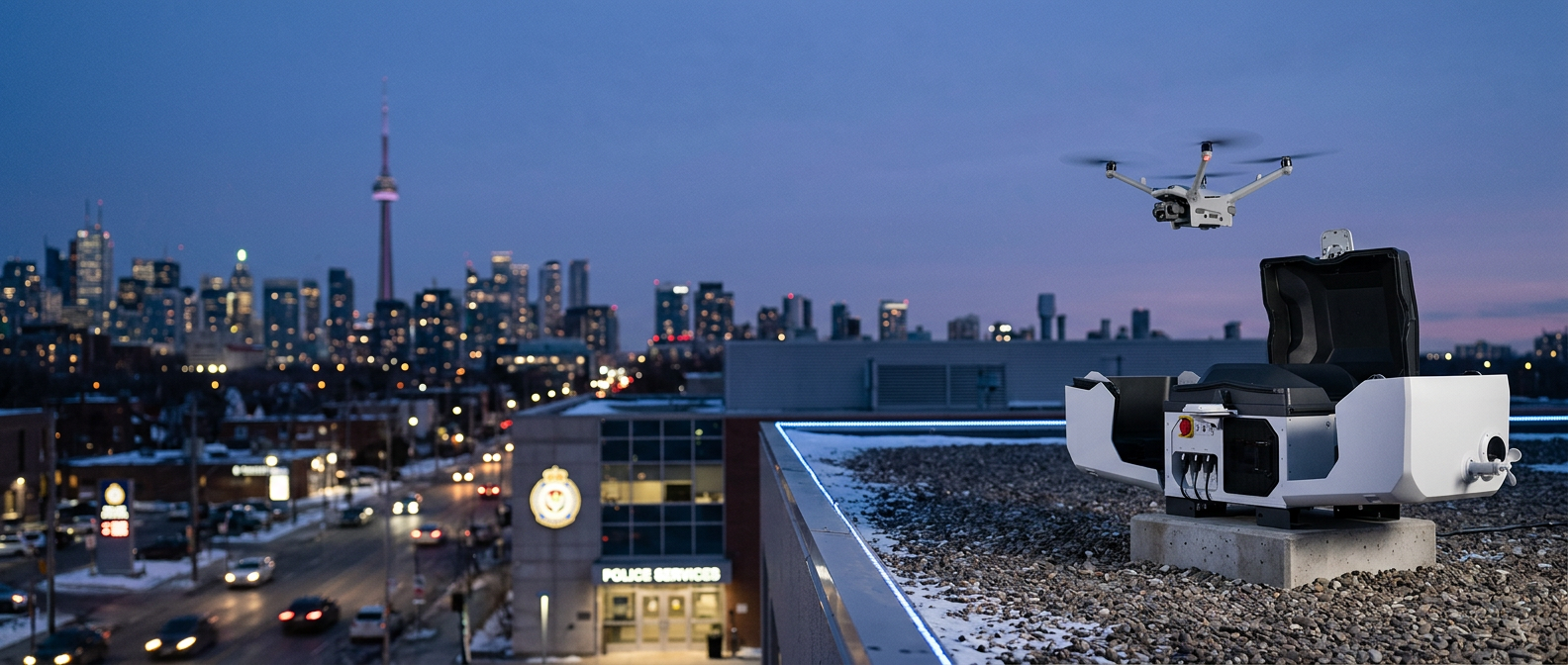
DJI Dock 3 on a Canadian police headquarters rooftop at dusk with the correct DJI Matrice 4TD launching from the open dock

Public Safety / DFR

Dock-led DFR programs for Canadian agencies

Built around DJI Dock 3 and the Matrice 4TD, our DFR deployments give police, fire, and EMS a fixed, always-ready launch point that puts thermal and RGB video overhead before ground units arrive.

Call 416 303 3575
Authorized DJI Enterprise dealerHextronics partner — CanadaParrot ANAFI tactical reseller

< 90 sec

Average drone-on-scene time once dispatched

24 / 7

Autonomous launch from rooftop or compound dock

100%

NDAA-compliant aircraft options for tactical units

The problem

Officers arrive blind. DFR fixes that.

In most agencies the first responding officer rolls up to a call with nothing more than a dispatch note. By the time they assess the scene, suspects have moved, victims have deteriorated, and the window for de-escalation has shrunk.

A DFR program puts a thermal-equipped aircraft overhead in the time it takes a cruiser to leave the parking lot — streaming live video to dispatch, the responding officer's MDT, and the incident commander. Decisions get made on fact, not assumption.

How DFR works

From 911 call to overhead video in under 90 seconds

01

Call comes in

CAD / 911 dispatcher pushes the incident GPS to the DFR operator console.

02

Drone auto-launches

Dock 3 or Hextronics Atlas opens, the aircraft takes off and flies a pre-cleared route — no pilot on scene required.

03

Live ISR to the incident commander

DroneSense or FlightHub 2 streams thermal + RGB video to officers en route, dispatch, and the EOC.

04

Auto-return & recharge

Aircraft lands itself, recharges, and is ready for the next call within minutes.

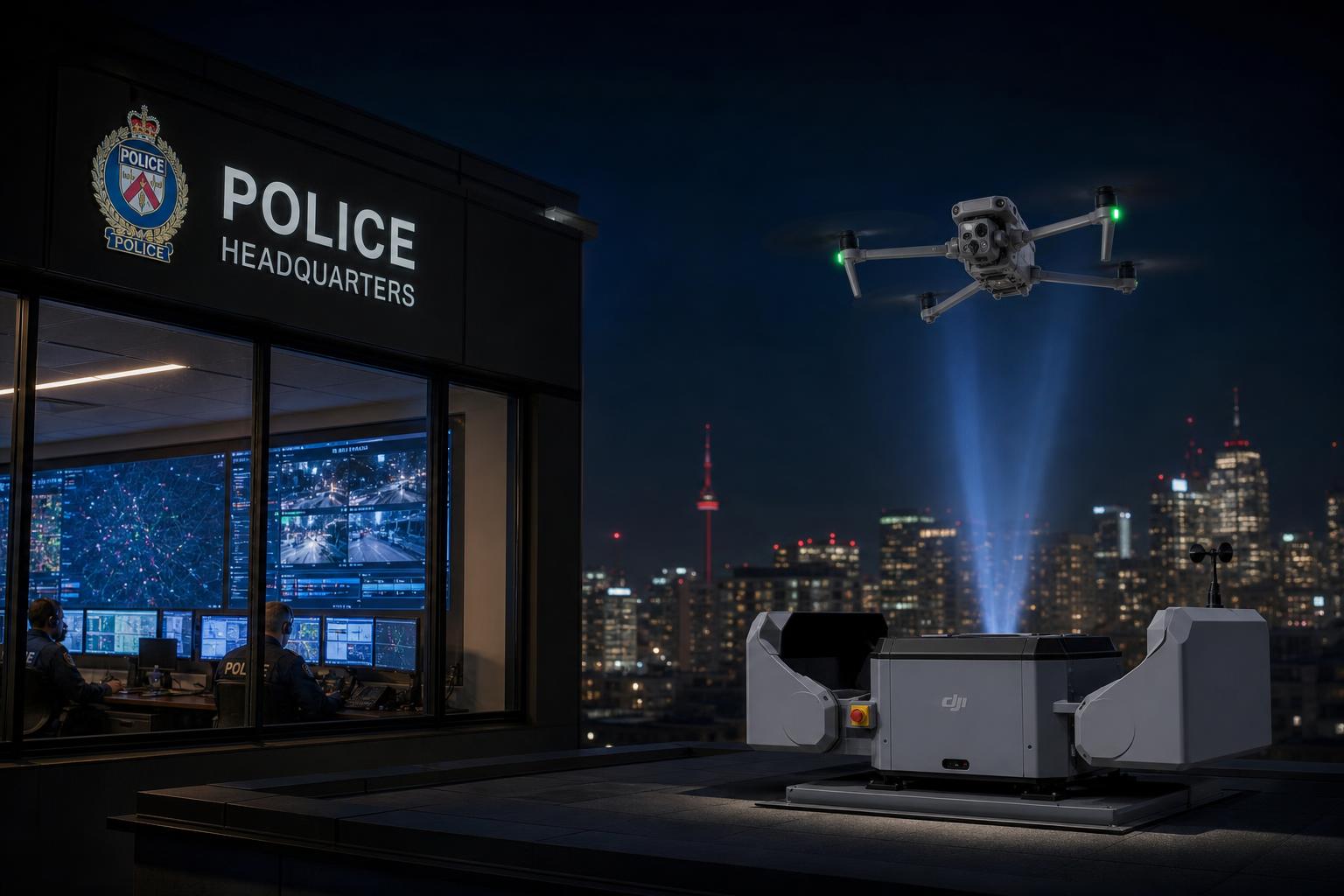
DJI Dock 3 and DJI Matrice 4TD supporting a Canadian police DFR operations center at night

Primary deployment model

DJI Dock 3 + Matrice 4TD is the core DFR stack

For most municipal DFR programs, the fixed-site dock is the system that changes response time. The dock stays installed, connected, and weather-ready while the Matrice 4TD handles thermal overwatch, scene confirmation, and incident commander video before officers arrive.

Why agencies start here

Permanent rooftop siting for repeatable launch geometry

Thermal + visible payload for pre-arrival scene assessment

Auto-return and recharge between calls

Mission profiles

One platform. Every public-safety use case.

Police & tactical

Active calls, perimeter containment, vehicle pursuits, search warrant overwatch, and crowd monitoring.

Fire & EMS

Pre-arrival size-up, thermal hot-spot detection, structure fires, MVCs, and HAZMAT plume tracking.

Search & rescue

Wide-area thermal sweeps for lost persons, water rescue spotting, and night-time SAR with strobe + spotlight payloads.

Critical infrastructure

Automated patrols of utilities, ports, correctional facilities, and large industrial campuses.

Platforms in the program

Docks, drones & ground stations

Every system below is supported, configured, and trained on by the Remote Robotic deployment team.

View full collection →

Compliance & regulatory

Cleared to fly. Cleared to defend in court.

  • Transport Canada RPAS Advanced Operations & BVLOS pathways
  • NDAA Section 848 compliant aircraft (Parrot ANAFI USA / UKR, Teal Black Widow, FreeFly Astro)
  • CJIS / criminal-justice data handling guidance for evidentiary footage
  • Site survey, airspace authorization, and SFOC support included with every deployment

FAQ

Drone as First Responder, answered

What is a Drone as First Responder (DFR) program?

+

A DFR program uses an automated, dock-based drone that launches the moment a 911 / CAD call comes in and streams live video to dispatch and responding officers — typically arriving on scene in under 90 seconds, well before ground units.

Is DFR legal in Canada?

+

Yes. DFR operations are conducted under Transport Canada RPAS Advanced Operations, with BVLOS authorizations issued via SFOC for fixed-dock and over-people scenarios. Remote Robotic supports agencies through the full application and risk-assessment process.

Which drones and docks do you deploy for DFR?

+

Our standard stack is DJI Dock 3 with the Matrice 4D / 4TD for full-feature deployments, Hextronics Atlas and Universal docks for multi-aircraft and NDAA fleets, and Parrot Anafi UKR / USA for NDAA-required tactical units.

How much does a DFR program cost?

+

A single-dock program typically lands between CAD $80–180K all-in (aircraft, dock, software, training, year-one support). Multi-dock municipal deployments scale from there. Request a quote for a scoped proposal.

Do you train our pilots and remote operators?

+

Yes — every deployment includes Transport Canada Advanced certification training, DFR remote-operator workshops, and ongoing tactics support for supervisors and IC officers.

Meet our public safety team

Programs guided by frontline experience

The people who scope, deliver, and support every Remote Robotic public safety program — built on decades of policing, aviation, and agency-side expertise.

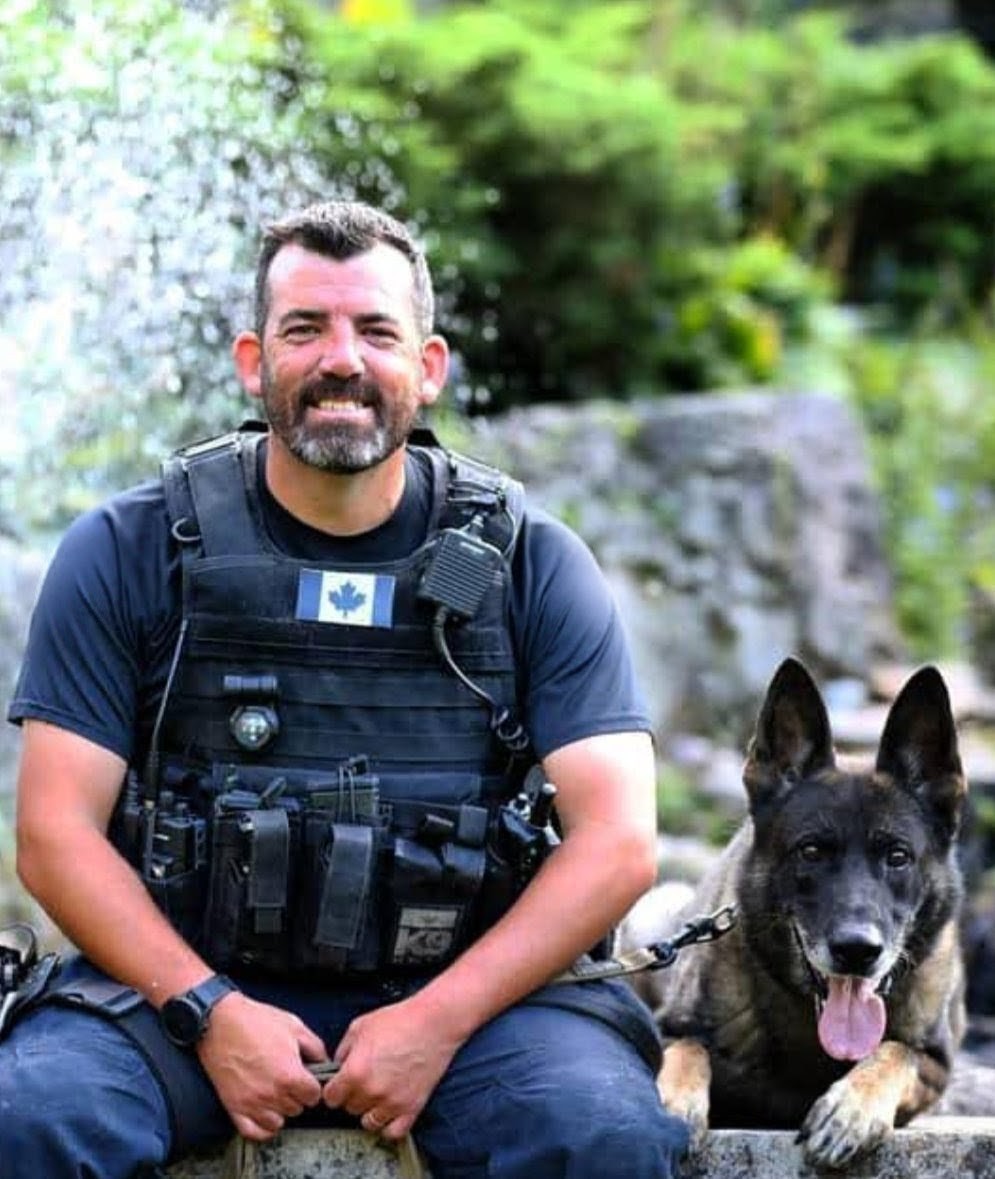
Jeffrey Burns in tactical kit with his police K9 partner

Jeffrey Burns

Director of Public Safety Programs

Remote Robotic Systems

Jeffrey Burns is a recognized public safety leader with more than 25 years of policing experience and extensive expertise integrating aviation, drone, robotic, and canine capabilities into operational environments. A former Tactical Flight Officer, K9 handler, and advanced RPAS & DFR operator, he has spent his career helping agencies enhance situational awareness, search operations, tactical response, and overall officer safety.

Throughout his service, Jeffrey has led and contributed to numerous high-profile programs, working closely with public safety organizations, academic institutions, and industry partners to advance practical technology solutions. His work emphasizes the successful integration of innovation into frontline operations, improving effectiveness, safety, and decision-making.

As Director of Public Safety Programs with Remote Robotic Systems, Jeffrey supports agencies across North America in the adoption, training, and deployment of advanced drone and robotic systems for public safety missions.

  • 25+ yrs policing
  • Tactical Flight Officer
  • K9 Handler
  • Advanced RPAS & DFR Operator
  • Public Safety Program Leader
Eric Bloemendal, Sr. Director of Sales — Public Safety at Remote Robotic Systems

Eric Bloemendal

Sr. Director of Sales — Public Safety

Remote Robotic Systems Inc.

Eric Bloemendal leads public safety sales for Remote Robotic Systems, partnering with police, fire, EMS, search & rescue, and security agencies across North America to scope and deploy drone and robotics programs that fit real operational requirements and budgets.

Eric works hand-in-hand with agency leadership, program managers, and procurement teams to translate mission goals into the right mix of aircraft, docks, payloads, software, and training — from a single tactical kit through full multi-site DFR deployments. He coordinates closely with the Remote Robotic engineering, training, and Transport Canada compliance teams to ensure every program is supportable on day one and scalable for the long term.

As Sr. Director of Sales — Public Safety with Remote Robotic Systems, Eric is the primary point of contact for agencies evaluating, procuring, and expanding their drone and robotics capabilities.

  • Public Safety Sales Lead
  • Agency Program Advisor
  • DFR & Tactical Programs
  • Coverage across North America
Randy Schulete, Public Safety Specialist at Remote Robotic Systems

Randy Schulete

Public Safety Specialist

Remote Robotic Systems Inc.

After 30 years of proud service with the Ontario Provincial Police, Randy has made the step into the corporate world. He brings 25 years of frontline experience in Emergency Response, including 13 years in a supervisory capacity, and now helps both law enforcement agencies and corporate clients adopt operationally sound technology solutions.

Randy's target areas of expertise are the use of uncrewed aircraft for frontline policing — particularly the integration of Drone as a First Responder (DFR) and industry remote drone solutions in the Canadian market — the integration of TAK into emergency response in the Canadian market, and the evolution of technology in search and rescue.

As a Public Safety Specialist with Remote Robotic Systems, Randy works with Canadian agencies to scope, deploy, and operationalize drone, robotics, and situational-awareness platforms that match real frontline workflows.

  • 30 yrs OPP
  • 13 yrs Supervisory
  • DFR — Canadian Market
  • TAK Integration
  • Search & Rescue Tech
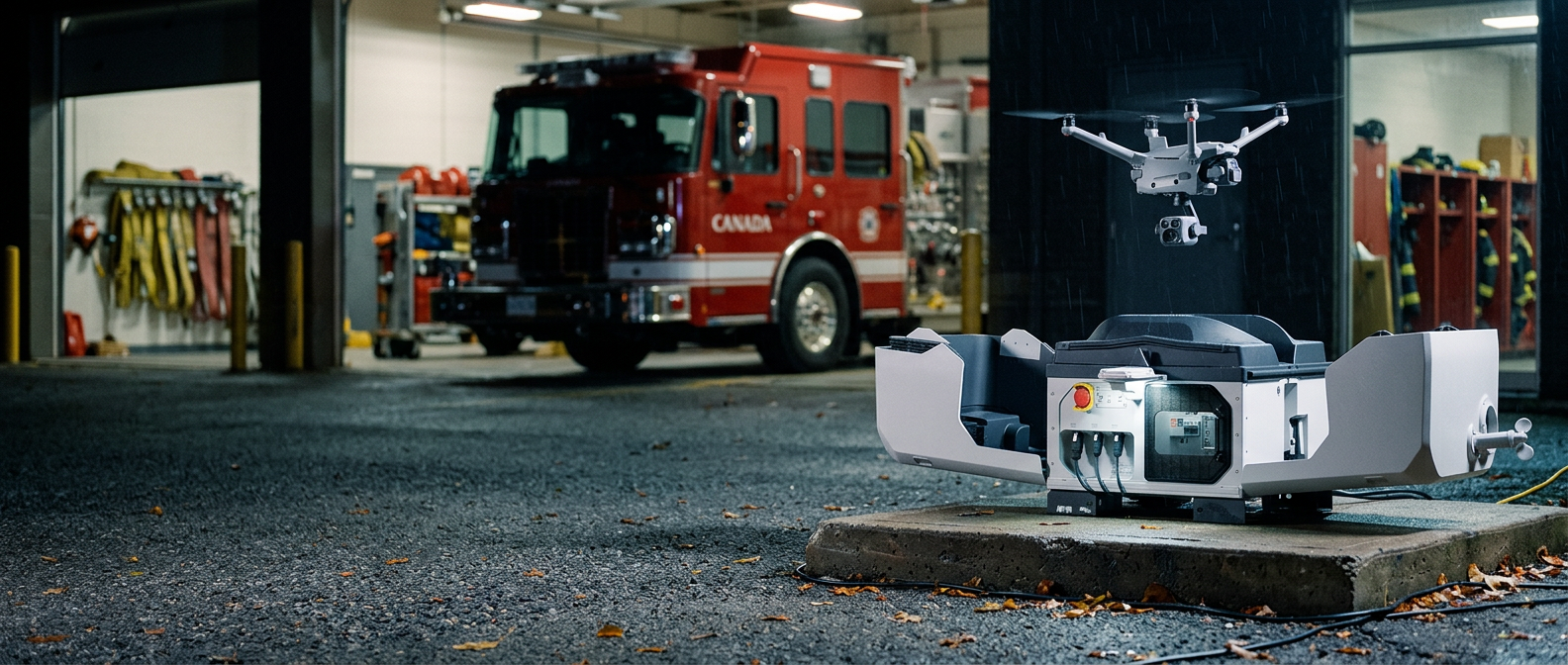
DJI Dock 3 at a Canadian fire station with the correct DJI Matrice 4TD lifting off after auto-launch

Next step

Scope your agency's DFR program

Tell us your jurisdiction, call volume, and existing aviation assets. We'll come back with an airspace-cleared, budget-scoped DFR proposal — typically within 3 business days.

Call 416 303 3575

Responses within 1 business day