Field Guide
Wildfire Hotspot Detection Drones in Canada: Thermal Aircraft & NDAA Options
How Canadian fire departments use thermal drones for wildfire hotspot detection, why no domestic manufacturer builds a wildland ISR platform, and which NDAA-compliant aircraft fill the gap.
Remote Robotic · July 2, 2026 · 8 min read
Wildfire season doesn't wait for a procurement cycle. By the time smoke is on the horizon, the departments with a thermal aircraft already in the truck are the ones finding hidden hotspots before they jump the line — and the ones without one are relying on a spotter plane that may not be available for hours.
Here's what's actually involved in equipping a Canadian agency for hotspot detection this season, including the one question we get on almost every call: why can't we just buy Canadian?
How do drones detect wildfire hotspots?
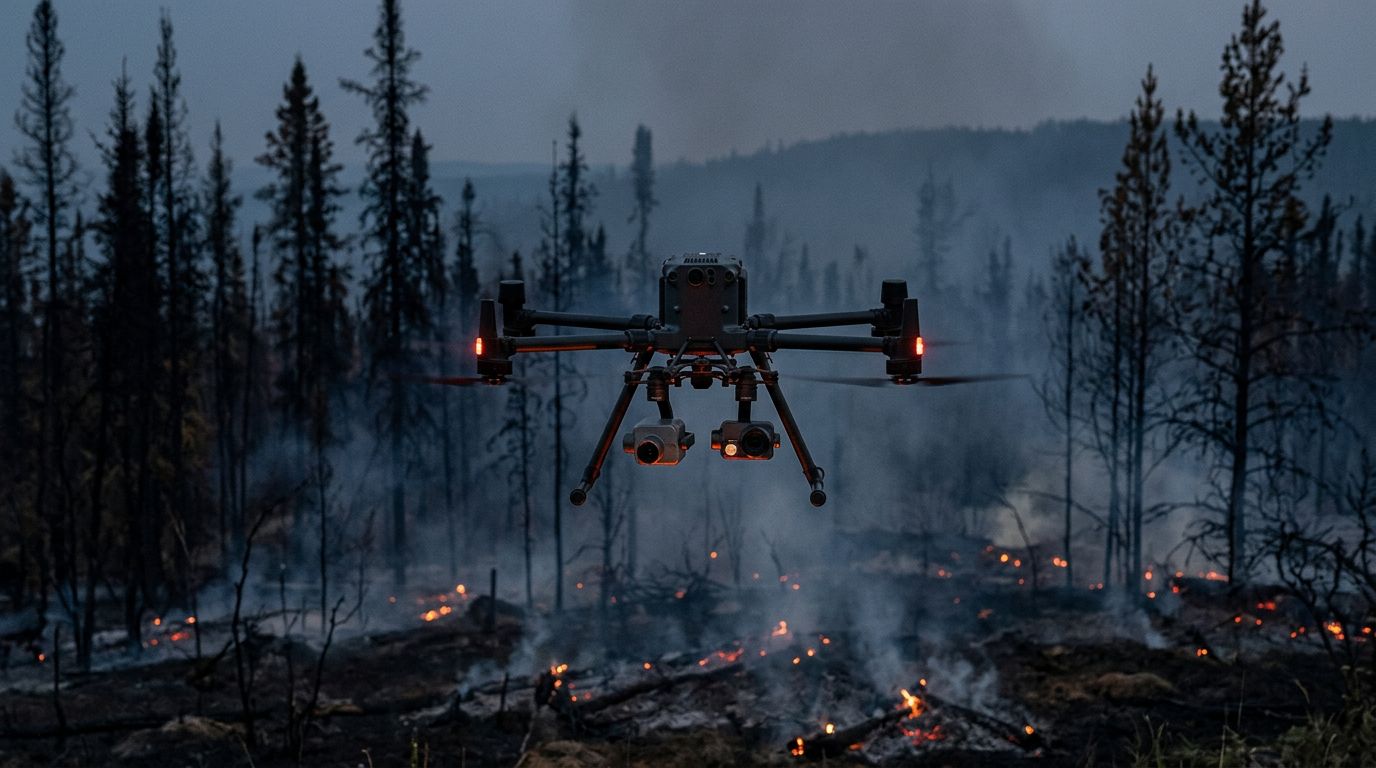
Drones detect wildfire hotspots using radiometric thermal cameras that read actual surface temperature, not just visible smoke or flame. A wildfire perimeter is easy to see. What's hard to see is the smoldering root system under a burned-over patch, the ember bed hiding under duff and canopy, or the flare-up waiting to reignite after a crew has already moved on. Ground crews and even helicopters miss these because visible light doesn't show elevated temperature — you need radiometric thermal, and you need it close enough to the ground to resolve a hotspot the size of a stump rather than a city block.
A radiometric sensor gives an operator an actual temperature reading per pixel, not just a "warm" false-color overlay — which means an incident commander can tell the difference between sun-baked rock and an active ember bed from the control screen. Fly that same sensor at night, when manned aviation is typically grounded for safety and regulatory reasons, and the aircraft becomes the only set of eyes watching the perimeter until dawn.
Where hotspot-detection drones help on a wildfire file
- Perimeter mapping — establishing containment lines and tracking spread direction against wind and terrain.
- Hotspot and overhaul verification — confirming a sector is genuinely out before crews are pulled, cutting re-ignition risk.
- Night surveillance — holding situational awareness on a fire that doesn't pause when the helicopters do.
- Structure protection triage — scanning the wildland-urban interface to prioritize which properties need defensible-space work first.
- Supply and equipment delivery — heavy-lift platforms moving hose packs, pumps, or medical supplies into terrain crews can't drive into.
For departments building a full aerial response program rather than a single wildfire kit, this same thermal capability also extends into Drone as First Responder (DFR) programs for year-round dispatch coverage.
Is there a Canadian-made drone for wildfire hotspot detection?
No — there is no deep bench of Canadian-manufactured, enterprise-grade thermal drones built specifically for wildfire ISR. For departments that need a purpose-built, radiometric-thermal wildland platform today, what's actually flying on Canadian fireground files is either DJI or one of the NDAA-compliant, allied-built alternatives.
That second category exists precisely because Canada doesn't have its own version of the U.S. NDAA / Blue UAS framework. There's no federal statute forcing Canadian agencies away from Chinese-manufactured airframes. But a growing number of federal departments, the RCMP, provincial police, and critical-infrastructure operators are voluntarily aligning their procurement to those U.S. standards anyway — for cybersecurity, data sovereignty, and interoperability with allied agencies. If your department falls into that category, or you simply want a non-Chinese supply chain as a matter of policy, the honest answer isn't "buy Canadian" — it's buy allied. Parrot (France), Teal Drones, Inspired Flight, and Ascent AeroSystems (all U.S.) build airframes that are on the active Blue UAS list and hold up in real wildland deployments.
Which thermal drones do Canadian fire departments actually fly?
For departments without a country-of-origin restriction: the DJI Matrice 4TD, with its integrated radiometric thermal camera, is the current standard on Canadian firegrounds — IP55-rated, with a built-in spotlight and speaker for structure work as well as wildland. For departments that want a modular payload setup, the Matrice 400 pairs with the Zenmuse H30T thermal payload and can be configured with the FlyCart 30 for heavy-lift resupply, extending that same thermal capability over much larger perimeters.
For departments that need a non-Chinese platform: Parrot ANAFI USA and ANAFI UKR are the leading NDAA-aligned alternatives, with Teal Black Widow and Inspired Flight's IF800 also on the active Blue UAS roster. If ground-level hazardous area entry is part of the file — a post-fire structure collapse, HAZMAT, or confined-space search — Boston Dynamics Spot rounds out the kit with thermal, gas, or 360° payloads on an NDAA-aligned platform.
We also carry standalone radiometric thermal payloads — Workswell and NextVision — for departments that want to build out an existing airframe rather than start from scratch. Full specs for every platform above are on our fire and rescue hardware page.
Compliance status changes with vendor SKU and firmware revision, so we confirm Blue UAS / NDAA status per platform at quote time rather than making blanket claims. If a country-of-origin requirement is written into your procurement policy, that's a conversation worth having before you buy, not after.
What does a wildfire hotspot detection drone program cost in Canada?
A starter thermal-equipped aircraft — with Transport Canada Advanced RPAS training, a spotlight/speaker payload, and airspace support — typically lands between CAD $20,000 and $55,000. Multi-aircraft fleet and multi-station programs scale up from there, and every deployment we run includes RPAS Advanced certification, fireground tactics training, and thermal interpretation training for the crews who'll actually be reading the screen at 2 a.m.
Before the season starts
The departments that get ahead of hotspot detection every year aren't the ones with the newest aircraft — they're the ones who scoped their call types, trained their crews before the first callout, and knew exactly which platform fit their operational and procurement requirements. If you're heading into this wildfire season without that in place, or you're reassessing whether your current aircraft meets a compliance requirement your agency has adopted, we can walk your team through what's actually deployed on Canadian firegrounds right now and what fits your response area.
Ready to scope your department's program? Request a proposal and we'll come back with a budget-scoped recommendation within one business day.
Shop the story
Related products in our catalog
Every product below is stocked and supported by Remote Robotic in Canada.
- DJI Zenmuse H30T
DJI Zenmuse H30T
Wide + 34× zoom + thermal (1280×1024) + laser rangefinder + NIR — the flagship M400 payload.
View product → - DJI Matrice 4TD
DJI Matrice 4TD
Dock-native thermal M4TD with NIR aux light — night-ops DFR and thermal patrol.
View product → - DJI Matrice 400
DJI Matrice 400
Flagship enterprise M400 airframe — 59 min flight, 6 kg payload, multi-sensor ready.
View product → - DJI Matrice 4T
DJI Matrice 4T
Multi-sensor M4 Series with thermal + NIR + laser rangefinder for inspection & public safety.
View product →