
Services / Proof-of-Concept Program
Test drones, robots, and sensors in your operation before committing.
Remote Robotic helps enterprise and public-sector teams validate advanced robotics solutions — drones, UGVs, ROVs, docking systems, and sensors — through a hands-on Proof-of-Concept (POC) program. Designed for utilities, public safety, mining, energy, and large industrial organizations that need clarity, ROI, and operational certainty before they invest.
✓
For enterprise & public-sector teams
✓
Hardware-agnostic, vendor-neutral
✓
Canada-wide remote and on-site support
What it is
A structured, time-bound engagement to answer specific business questions.
We bring the right combination of robotics technology and expertise into your environment so your team can evaluate — not just demo — the platforms you're considering.
Common questions we answer
- — "Can drones safely replace our helicopter inspections?"
- — "Will a ground robot or docked drone reduce our response times?"
- — "Which drone and sensor combo is best for our mapping or inspection work?"
- — "Is BVLOS or remote operations viable for our sites?"
Who it's for
- — Operations leaders validating safety and productivity gains
- — Innovation teams moving from interesting pilot to scalable deployment
- — Procurement & leadership gaining confidence in capital decisions with real data
Two ways to engage
Pick the engagement that matches your maturity
Option 1
Equipment-specific proof-of-concept
Ideal if you already know which platform you want to test.
Use cases
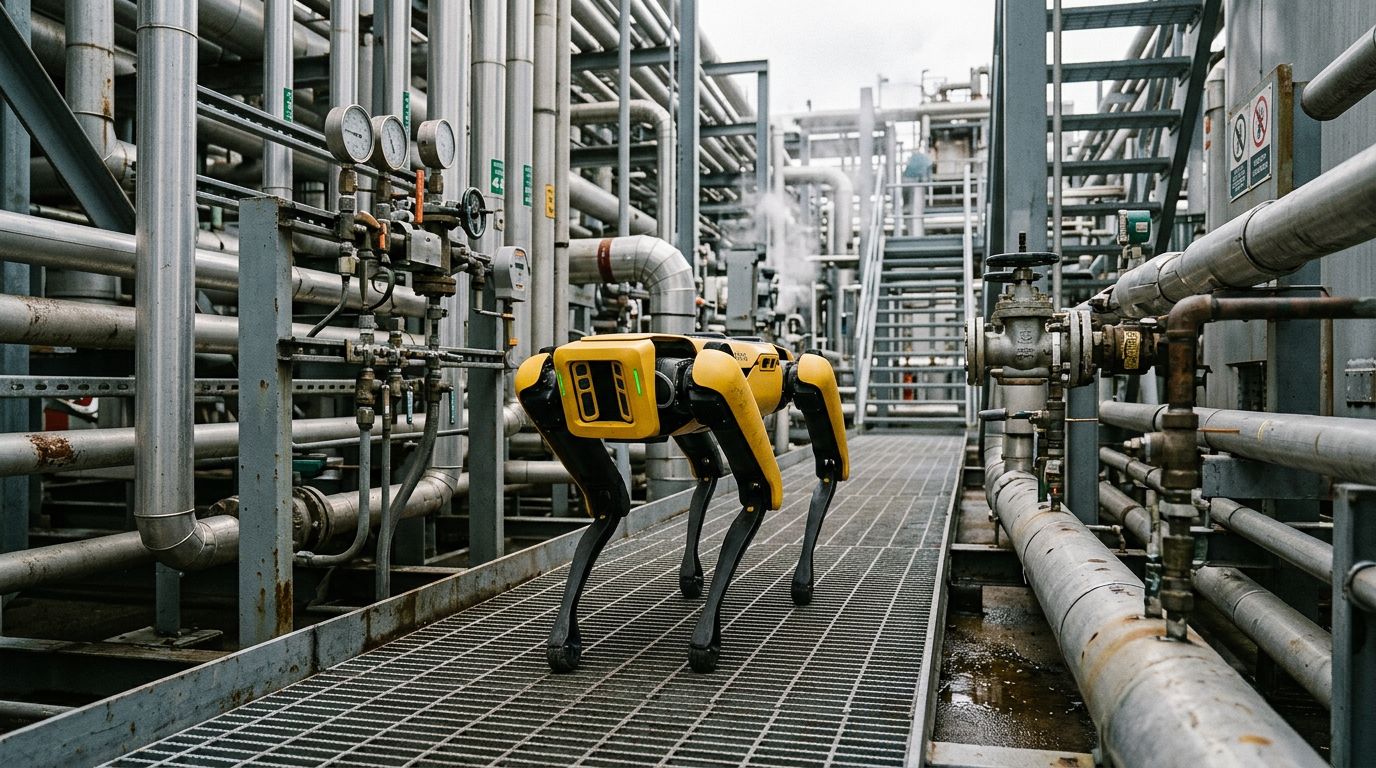
- — Trial a specific drone (e.g. DJI Matrice 400), UGV (Spot, Husky), or ROV
- — Compare multiple platforms head-to-head
- — Validate for inspections, mapping, emergency response, or automation
We deliver
- — Test plan creation
- — On-site or remote deployment
- — Training & operational support
- — Performance evaluation and ROI analysis
Option 2
Consultative robotics assessment & POC
Ideal if you know the problem but need clarity on the right technology stack.
We help you determine
- — Which drones, robots, or sensors match your goals
- — What software, data workflow, or docking system is required
- — Whether BVLOS, remote ops, or autonomy is viable
- — Total cost of ownership and scalability
Includes discovery, workflow mapping, system recommendations, POC execution, and a scaling roadmap.
Apply →How it works
A three-step program built around your KPIs
Requirements & success metrics
We identify mission needs, regulatory constraints, existing workflows, and the KPIs that will define success.
Solution design
We select the right combination of drones, robots, sensors, software, and data workflows for the test plan.
Deployment & training
We configure hardware, train your operators, support mission execution, and deliver a performance & ROI report.
What's included
Everything you need to evaluate fairly
- Technology selection & guidance
- Access to drones, robots, sensors, or software
- Configuration and on-site / remote support
- Training for operators, managers, and leadership
- Mission execution support
- Performance evaluation and ROI analysis
Outcomes & ROI
Real-world evidence — before you buy
- Confident yes/no decision backed by measurable performance
- Risk reduction in operational, safety, and budget decisions
- Aligned stakeholders with shared, real-world data
- Roadmap for scaling robotics across sites or departments
- Clarity on long-term cost, training, and support requirements
FAQ
POC, answered
- What is a robotics proof-of-concept?
- A structured, time-bound test that evaluates drones, robots, and sensors in your real operation to confirm performance, ROI, and safety before committing to a full purchase.
- Why do organizations run a POC?
- To reduce risk, gather measurable evidence, compare technologies head-to-head, and validate ROI against current workflows — instead of buying off a spec sheet.
- How long does a POC take?
- Most run 4–12 weeks, depending on scope, test environment, and internal approvals.
- Which technologies can we test?
- Drones (DJI Matrice, Parrot, Teal, FreeFly), UGVs (Spot, Husky, Jackal), ROVs, autonomous docking systems, BVLOS platforms, LiDAR, thermal and multispectral sensors, magnetometers, and mission software.
- Do you provide training?
- Yes. Operator and supervisor training is included so your team can run the evaluation accurately and capture clean performance data.
- How much does a POC cost?
- Pricing depends on technology scope, duration, and support level. Most engagements are scoped during a discovery call — request a briefing below and we'll come back with a fixed-price proposal.
Validate the technology. De-risk the investment.
Tell us your mission, your sites, and what success looks like. We'll scope a POC that answers it — usually in 4–12 weeks.