
ROC – Remote Operation Center
Docked and Ready — Inside Imperial Oil's Drone-in-a-Box Strategy
A ROAR West conversation with Imperial Oil's UAS expert on why a dock is valued by coverage, the goal of a dock at every site, and the weather and cost limits that decide how far it scales.
Remote Robotic · October 22, 2026 · 4 min read
Watch the ROAR West conversation
Watch on YouTube ↗What drone-in-a-box means
A drone sitting in a box, ready to launch itself on a schedule or a trigger, without a pilot walking out to unpack it — that's the simplest way to describe "drone-in-a-box," and it's become the backbone of how Imperial Oil thinks about field surveillance at scale.
From Cold Lake pilot to operations
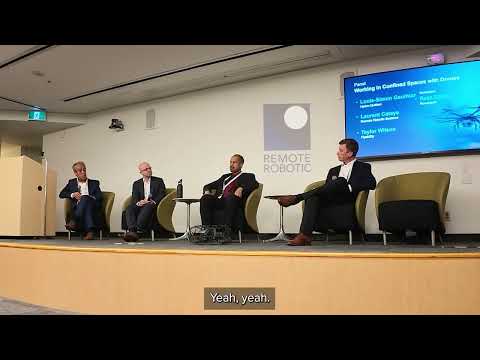
Nathan Workington, Imperial's UAS subject matter expert, dates the program's start precisely: it began at Cold Lake in 2024 and went operational in 2025. The goal wasn't inspection in the way most people picture drone use — flying up to a flare stack or a tank. It was continuous surveillance over a sprawling field asset. "We're really looking for liquid leak detection, you know, active spills that we can stop," Workington explained in a recent ROAR West conversation with Remote Robotic. "If we can get better at containing our products in the pipe, then we're just better at doing our environmental performance. And of course, less spills cost less money as well."
A dock is valued by coverage
That framing matters: a dock isn't valued the way a single inspection drone is, by the quality of one flight. It's valued by coverage — how much ground it watches, how often, without someone having to decide to send it. A fixed dock, paired with a detect-and-avoid radar system, can fly a route automatically, land, charge, and go again, which is what makes it realistic to cover a large asset rather than just the specific piece of equipment someone remembered to inspect that week.
A dock at every site
The ambition for where this goes next is specific and large. Imperial operates 36 field terminal sites across Canada, in addition to its refineries and mining assets, and Workington's stated goal is a dock at every single one of them — each viewable live by anyone in the organization, piloted from the office or remotely from Calgary. "I would love to see a minimum of one dock, dock on it, every single location," he said.
Alberta weather sets the limits
Getting there runs straight into Alberta weather. Most commercial drones are only rated to operate down to around -20°C, which effectively shuts a dock down for a large chunk of the Canadian winter. "If they're only good to -20... now half your winter in our northern areas, they're not going to fly," Workington said, pointing to a far-north site in Northern Wells that Imperial wants to cover more aggressively but is holding off on until -40°C-capable equipment exists. Wind is the other hard limit: most drones ground themselves around 43–45 km/h gusts, a standard Workington said has barely moved in five or six years, and he's actively hoping manufacturers push that threshold toward 60–70 km/h.
The cost problem worth solving
Cost shapes the dock strategy too, in a direction that might surprise people focused on long-range capability. Workington was candid that the headline-grabbing, long-distance beyond-visual-line-of-sight use case isn't where Imperial sees the most value for a dock program, because that kind of mission happens rarely. What actually matters for day-to-day dock operations is affordable, localized detect-and-avoid coverage — radar or detection sized for a two-to-three-kilometer radius around a single site, not a system built to cover a whole region. Solve that cost problem, and a dock at every terminal stops being aspirational and starts being an ordinary line item.
An infrastructure story
The pattern underneath all of this: a dock isn't really a drone story. It's an infrastructure story — fixed, always-there coverage that only becomes valuable once you can trust it to operate unattended, in weather, at a cost that scales across dozens of sites rather than one showcase location.
That's the model behind our Remote Operations Center (ROC) program and our dock drone solutions. To talk through docks for your sites, contact our team.
ROC program
Talk to the ROC team
Shop the story
Related products in our catalog
Every product below is stocked and supported by Remote Robotic in Canada.