
ROC – Remote Operation Center
“We Don't Fly Drones for Fun” — How Imperial Oil Actually Evaluates and Scales a Robotics Program
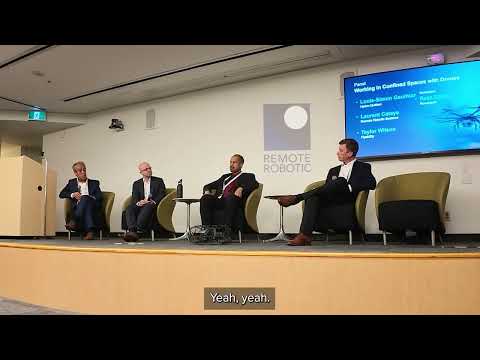
A ROAR West conversation with Imperial Oil's UAS expert on how the company picks vendors, builds the internal case for a program, and clears its three-part bar: reduce cost, reduce downtime, reduce risk.
Remote Robotic · October 22, 2026 · 5 min read
Watch the ROAR West conversation
Watch on YouTube ↗Value first — and safety counts as value
Ask most people how a major industrial company picks which robotics investment to make next, and you'll get a guess involving budgets, executive mandates, or whichever vendor has the best sales deck. Ask Nathan Workington, Imperial Oil's UAS subject matter expert, and the answer is considerably more disciplined — and more instructive.
"We're an oil and gas company. That's all based on delivering shareholder value," Workington told Remote Robotic's Laurent Cataye at a recent ROAR West conversation. "We chase the biggest value first, the lowest hanging fruit, and then we just kind of go from there." But value, in his framing, isn't only measured in dollars saved on production. "A safety reduction can be just as costly to the company as a production impact." A proof of concept that reduces risk gets evaluated with the same seriousness as one that reduces cost.
That discipline shows up most clearly in three places: how Imperial chooses vendors, how it builds the internal case for a new program, and how long it's willing to let that case take shape.
Vendors are evaluated front-to-back
Vendor evaluation is front-to-back, not just a purchase decision. "We really like to see companies that have well-established front-to-back robotics programs. It's not just sales," Workington said. "We don't want to just buy robots from anybody. We want to actually see that there's support throughout it." Imperial also weighs business model flexibility — outright purchase versus a service agreement where the vendor continually updates the platform for a recurring fee — and prefers Canadian vendors when the value case holds up, though that preference never overrides delivering results.
Every proof of concept is a real evaluation
Every proof of concept starts as a real agreement with a defined evaluation period, after which Imperial assesses honestly: did it bring the value expected, more than expected, or none at all — and if it underdelivered, what would need to change to get there. That's a meaningfully different posture than treating a pilot as a foregone conclusion once the equipment arrives on site.
Building the internal case takes over a year
Building the internal case takes time — often more than a year. "That took probably over a year's worth of time of just developing that type of conversation," Workington said of getting Imperial's business lines aligned behind its BVLOS remote operations program. The case has to go well beyond the obvious value: what will the radar cost, where will remote operations be based, what will that infrastructure cost the project, and — critically — what will weather downtime actually look like. Imperial's own numbers got stress-tested by what Workington called "the most challenging calendar year in the history of Alberta" for operating robotics: brutal cold, heavy snow, and unprecedented rain. Rather than undermining the business case, that worst-case year became useful data. "This is the least amount of data that you're going to get from our concept," Workington said of the pitch to business lines now. "It can only be more from here."
The three-part bar
Underneath all of it is a principle Workington returns to repeatedly: every initiative has to clear a three-part bar — reduce cost, reduce downtime, and reduce risk. "We don't have the luxury of just doing drones for fun," he said. "Everything that we do has to have a value add to the business."
What he'd do differently: people, not technology
Asked what he'd do differently if he were starting Imperial's program over, Workington didn't point to technology choices. He pointed to people: "I would focus on who we chatted with at each asset a little bit more." Imperial's mining operation, he said, lagged in adoption partly because of how early conversations with that business line were handled — a reminder that even a well-run technology program lives or dies on the internal relationships built around it, not just the hardware.
The takeaway
For any organization building a business case for robotics or drones, the throughline from Imperial's experience is this: the technology is rarely the hard part. The hard part — and the part worth investing real time in — is building a rigorous, honest, cross-functional case that survives contact with a genuinely bad year.
That's how we approach managed ROC drone programs: one predictable recurring fee, a defined evaluation period, and a vendor accountable for support front to back. If you're building the case for your own program, start with our industrial inspection solutions or ask us about a managed program.
ROC program
Talk to the ROC team
Shop the story
Related products in our catalog
Every product below is stocked and supported by Remote Robotic in Canada.