
Industrial Robotics
One Pane of Glass: Why Imperial Oil Wants Its Drones and Robot Dogs Talking to Each Other
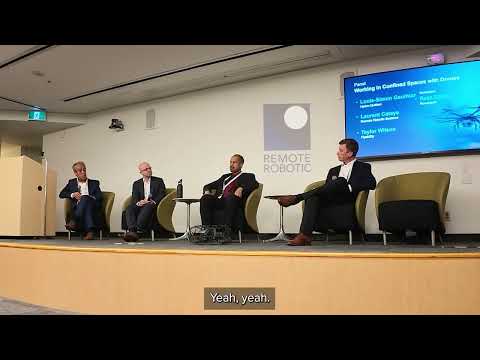
A ROAR West conversation with Imperial Oil's UAS expert on moving from single-use robots to integrated operations — where Spot robot dogs and inspection drones trigger each other and feed one shared picture.
Remote Robotic · October 22, 2026 · 5 min read
Watch the ROAR West conversation
Watch on YouTube ↗Most industrial robotics programs start the same way
One use case, one piece of hardware, deployed to solve one specific problem. At Imperial Oil, that starting point was Spot, Boston Dynamics' quadruped robot, sent out to read analog gauges on older plants that never had digital instrumentation installed.
"A lot of our systems like to run on DCS or whichever for controls in the control room," explained Nathan Workington, Imperial's UAS subject matter expert, in a recent conversation with Remote Robotic at ROAR West. "So Spot's going out and looking at the manual gauges, and then we have an AI program that's converting manual gauge readings into digital values, and then coming into the actual control system so that we can make better decisions."
That was the entry point. It did not stay the only use case for long.
Once the robot is already walking the plant, thermal data costs almost nothing
"Whether it's Spot or drones, we see that all the time," Workington said. "We came in and it was Spot trying to get gauge readings. But then, of course, you have thermal sensors and other sensors that you can have on Spot." Once the robot was already walking the plant daily, the marginal cost of also capturing thermal data — multiple times a day, from the exact same vantage point, consistently — was close to zero. That consistency is what unlocks real analysis: trending temperature data over time, building differential calculations, and moving from reactive maintenance to genuinely predictive maintenance.
This is where Imperial's thinking has moved next: integration between robot types
Not just expansion within one. "I don't want to see Spot operating on its own, and us take our drones and operate drones all by ourselves," Workington said. "If Spot's going around the plant and it sees something at a height on a tank that it can't get a good vantage point of, it should trigger a drone to go over there and have a good look. And vice versa — if we're doing a drone flyby and it sees something on the ground that it can't see very well, it should trigger Spot to go and have a look at that."
The vision: one pane of glass
What Workington described is a single interface — "one pane of glass" — where ground robots and aerial drones hand off to each other automatically based on what each is best positioned to see, with all the resulting data flowing into one system rather than fragmented across separate platforms that "don't talk to each other."
The honest, unresolved part of the story
That fragmentation is the honest, unresolved part of the story. Workington was candid that Imperial, like most large organizations, still has siloed data: one platform for drone data, another for ground-robot data, with business lines and digital teams not always in sync on how workflows connect. Getting that integration right, he said, is a multi-year effort — but one that should pay for itself the moment it exists, simply because a plant that sees its own anomalies faster, from whichever angle catches them first, runs safer and more efficiently.
The lesson for any organization running more than one type of robot: the real ceiling on value isn't the capability of any single machine. It's whether your systems are set up to let them tip each other off.
That's the conversation Remote Robotic has with industrial teams every day — not which robot to buy, but how to get every machine on site seeing the same picture. If that's where your program is headed, take a look at our Remote Operations Center (ROC) program and industrial inspection solutions, or ask us about a managed program.
Shop the story
Related products in our catalog
Every product below is stocked and supported by Remote Robotic in Canada.
- DJI Dock 3
DJI Dock 3
Automated dock for Matrice 4D and Matrice 4TD remote inspection programs.
View product → - DJI Matrice 4TD
DJI Matrice 4TD
Dock-native thermal M4TD with NIR aux light — night-ops DFR and thermal patrol.
View product → - Boston Dynamics Spot
Boston Dynamics Spot
Agile ground robot for inspection and GPS-denied scanning payloads.
View product →