
Confined-Space Inspection
Why We Send Drones Where We Can't Send People
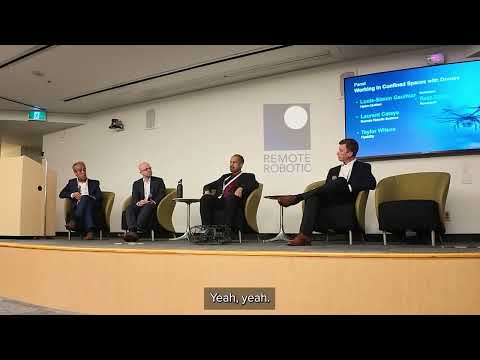
A utility panel explores confined-space drone inspections, Hydro-Québec and BC Hydro examples, and the question of whether anyone needs to enter a hazardous space at all.
Remote Robotic · October 9, 2026 · 8 min read
Watch the confined-space inspection panel
Watch on YouTube ↗The real question isn't what PPE to wear
North America logs roughly 150 to 200 confined-space fatalities a year, and 60% of the people who die are would-be rescuers who went in after someone else got into trouble. That's the number Taylor Wilson, country manager at Flyability, opened with on a recent utility panel on confined-space drone inspections — because once something goes wrong in a confined space, the problem cascades as more people go down to help.
The standard response has been more personal protective equipment: safety glasses, harnesses, gas monitors, lifelines. Laurent, from Remote Robotic Systems, argues that's the wrong starting question. Putting PPE on a worker already assumes someone has to go in. The question worth asking before every job isn't "what PPE do I need" — it's "do I need to send someone down at all." Technology keeps changing the answer, so it's worth re-asking every few months, not settling once.
Sometimes a drone can do the job instead. Sometimes it's a ground robot. Sometimes nothing exists yet that can replace the person. But the default question has quietly shifted from protecting the person sent in, to whether anyone needs to be sent at all.
What it looks like in practice
Hydro-Québec's robotics and drone program manager described three recurring situations where drones changed the outcome:
Complex outages. Inspecting a trench at a power plant on the Saint-Maurice River used to be a planned 40-hour job — scaffolding, lifelines, months of lead time. With a drone, the same inspection takes about 10 hours: a 75% cut in effort.
Scouting before committing a worker. Inside power plant gates, a drone now flies the space first so the team can decide whether a worker needs to go in at all, rather than sending someone in blind.
Spaces people can no longer safely enter. At the LG2 generating station, 12 concrete tunnels roughly 500 feet long connect the generators to the substation. Security requirements ruled out lowering a worker by elevator, so the team flew the inspection with a small confined-space drone instead — the first time that inspection had been done since the plant went into service.
That last case is the one he keeps coming back to: as the infrastructure ages, utilities are finding gaps in inspection history that were simply never safe or feasible to close before.
Flying into a tunnel isn't risk-free
Replacing a person with a drone doesn't eliminate risk — it changes what kind of risk you're managing. Confined-space drones have short flight times, so a pilot has to plan the mission carefully enough to know the drone can get back out before the battery runs down. Get that wrong, and the downside is a lost or damaged drone, not a lost life.
Laurent's team learned this firsthand during a tunnel inspection at a power station: a small piece of paper on the tunnel floor got pulled into the propellers and crashed the drone. It was repairable and no one was hurt, but the lesson stuck — something as small as a stray piece of paper can take a drone down, so pre-mission planning has to account for it. As the team puts it, "we don't fall in love with technology, we fall in love with the problems."
The mitigation is mostly procedural: understanding the mission, defining a recoverable flight path up front, and training pilots to handle the unexpected rather than trusting the hardware to handle it for them.
More sensors, earlier warnings
Once an inspection isn't limited to what a person can physically carry, it changes shape. A human inspector has two hands and maybe one or two instruments. A drone can carry a 4K camera, a thermal camera, a UV camera, gas detectors, and thickness gauges on the same flight, and reach behind, above, and underneath equipment that a stationary laser scanner would miss entirely.
That broader sensor coverage changes what gets caught, and when. A thermal camera finds hot spots, but a hot spot usually means damage has already started. A UV camera, further down the light spectrum, can pick up the corona effect on high-voltage equipment — a signal that trouble is building before anything fails. What matters isn't a single reading but the trend: stable corona activity is fine, a rising one is a maintenance flag before it becomes an outage.
Hydro-Québec is now feeding this inspection data directly into its asset management planning, using it to prioritize which aging assets get engineering attention first. One active project: roughly 200 substation roofs and attic spaces are being lined up for a dedicated drone inspection program feeding that same decision-making process.
Building the business case
When it's time to put a number in front of a budget approver, Flyability's Taylor Wilson splits the case into two buckets: health, safety and wellness, and commercial impact. On the safety side, the metric is labor hours moved out of confined spaces, off scaffolding, and out of rope access. On the commercial side, the biggest line item is usually avoided downtime, followed by avoided scaffolding and rope-access costs, avoided unplanned outages, and the administrative cost of training and compliance for confined-space entry.
Two examples from Remote Robotic Systems's own client work put numbers on that:
An oil and gas company ran quarterly inspections across three parallel production lines — roughly once a month across the set. Each one used to take two full days once PPE, confined-space entry, and lockout/tagout procedures were factored in. Flying the inspection instead, the crew started the permit work at 9 a.m. and was done by noon.
BC Hydro had a set of aging, energized underground vaults in Victoria where shutting off power to the whole neighborhood was the only way to send a person in safely — not something BC Hydro wanted to do routinely. The fix wasn't even a drone: a ground robot, redeployed from substation inspection duty, went underground instead and collected the data without cutting power to anyone.
Hydro-Québec's own numbers land in the same range: a 60–90% reduction in work effort on jobs that move into confined spaces, on top of inspections that weren't feasible to do at all before.
It's not just planned inspections
Confined-space drones also get used when something breaks and nobody has days to figure out why.
In one case, a vibration alarm shut down a generator on a river. Sending a full team in to check it out would have taken days, maybe weeks. Instead, a drone went into the tailrace for a quick look under the turbine, confirmed there was no debris and nothing urgent, and the operator put the generator back on the grid the same day.
In another, a distribution line serving an island kept cutting in and out with no obvious cause. The only way out there was by boat — plus a rescue boat as backup — to inspect a single pole. A drone ruled out the pole as the problem in minutes, and the crew moved on without the logistics of a full marine trip.
Where this is headed
Three trends came up repeatedly on the panel:
1. Dangerous to remote. Pilots increasingly operate from outside the hazard entirely, sometimes from a different city altogether.
2. Manual to autonomous. Drones are taking on more of the routine flying themselves, with pilots shifting toward monitoring for anomalies rather than flying every second of a mission.
3. Data collection to intelligence. A drone might capture 5,000 photos on one inspection, and today a person still has to review most of them. AI is starting to change that — surfacing the handful of frames that actually matter instead of handing back the whole data dump.
Edge computing on the drones themselves should push this further: real-time overlays that flag defects and obstacles as the pilot flies, not just after the data comes back.
Two limits came up in the Q&A, worth stating plainly. These drones navigate using SLAM (simultaneous localization and mapping) rather than GPS, which isn't reliably available underground or inside metal structures — which is also why a standard outdoor drone, even caged, can struggle with the gusty updrafts inside a space like a penstock, where a purpose-built confined-space drone is designed for it. And the onboard sensors are built for navigation, not millimeter-accurate measurement — useful for spotting changes like concrete degradation over time, but not yet a replacement for survey-grade equipment when a job calls for precise deformation tracking.
The shift in one line
The common thread across every example — Hydro-Québec's tunnels, BC Hydro's vaults, the oil and gas platform, the island pole — isn't really about drones. It's about an organization that stopped assuming a person had to go first.
That's the conversation Remote Robotic Systems has with utilities every day: not which drone to buy, but which jobs still assume someone needs to be in harm's way, and whether that's still true. If you're asking that question about your own confined spaces, take a look at our confined-space inspection drones and utility inspection solutions, or ask about a managed inspection program.