
Industrial Brief
DJI Drones for Energy & Utility Inspection in Canada: The Complete Guide
Which DJI drone for utility inspection? Compare the Matrice 4T, Matrice 400, and DJI Dock 3 for substation thermal, transmission corona, line patrols, and autonomous rounds — plus the corona and ground-robot systems that complete a Canadian utility program.
Remote Robotic · August 27, 2026 · 9 min read
Last verified against DJI's published specifications: July 2026.
Why Platform Choice Matters in Utilities
Utility inspection spans a huge range — a quick thermal scan of a substation transformer, corona detection along a transmission line, a scheduled overnight perimeter patrol — and no single aircraft does all of it well. The variables are payload (an integrated thermal camera versus a specialist UV corona sensor), autonomy (a crew-flown check versus a dock on a timer), and weather-hardening for year-round Canadian operation.
DJI's utility-relevant lineup splits cleanly along those lines: a compact thermal inspection aircraft, a heavy-lift platform for corona and heavy radiometric payloads, and an autonomous dock. The rest of this guide walks each, and where it hands off to a specialist or ground platform.
The DJI Utility Lineup at a Glance
| Platform | Class | Best utility use | Payload | Detailed guide |
|---|---|---|---|---|
| Matrice 4T | Compact inspection quad | Substation thermal, line patrols | Integrated thermal + 112x zoom + rangefinder | 4T utility guide |
| Matrice 400 | Heavy-lift quad | Transmission corona, heavy radiometric | 6 kg, gimbal payloads | M400 utility guide |
| DJI Dock 3 + Matrice 4TD | Autonomous dock system | 24/7 substation & perimeter rounds | Integrated thermal + rangefinder | Dock 3 utility guide |
Matrice 4T — The Compact, Foldable, Transportable Thermal Inspection Workhorse
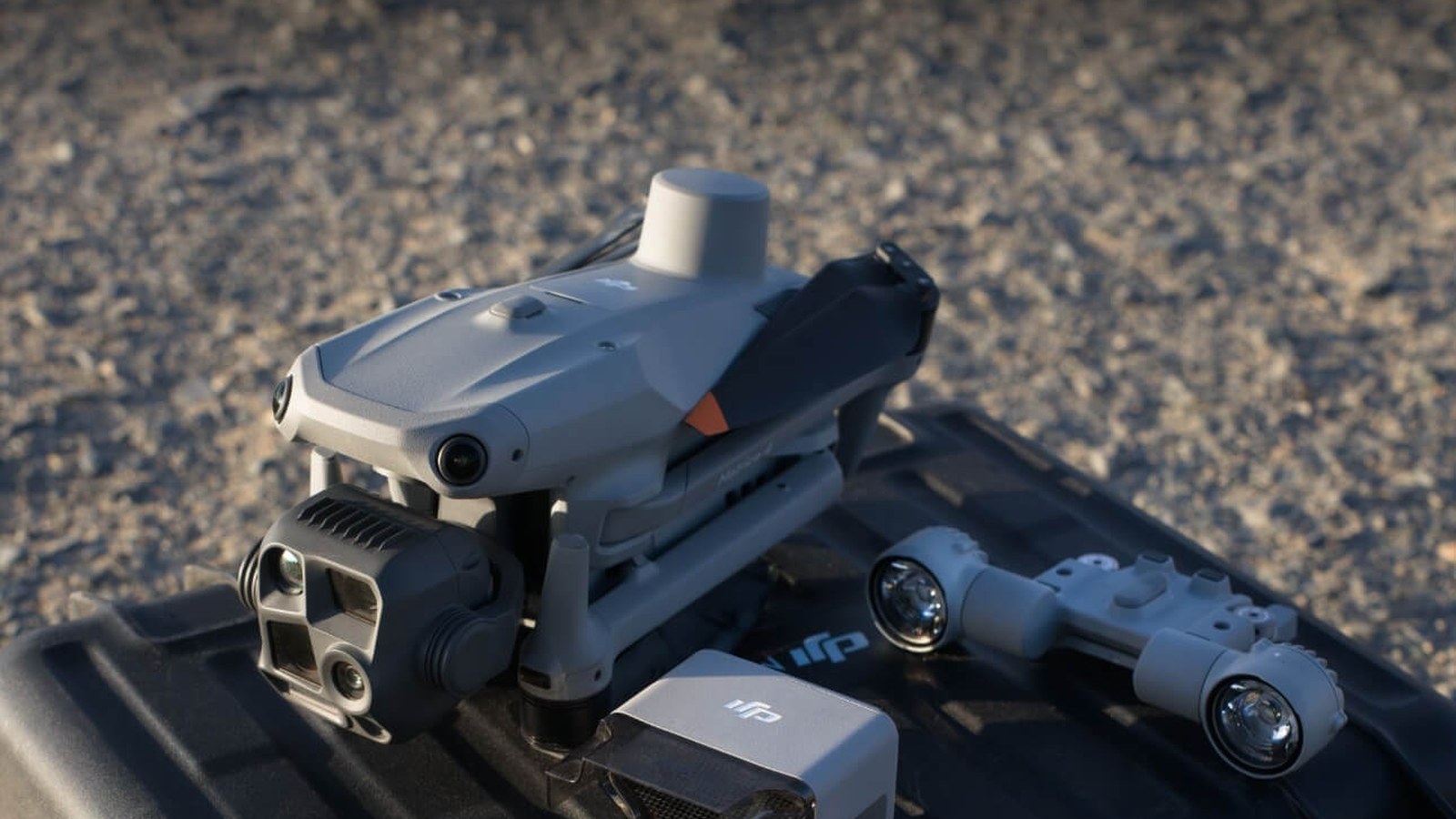
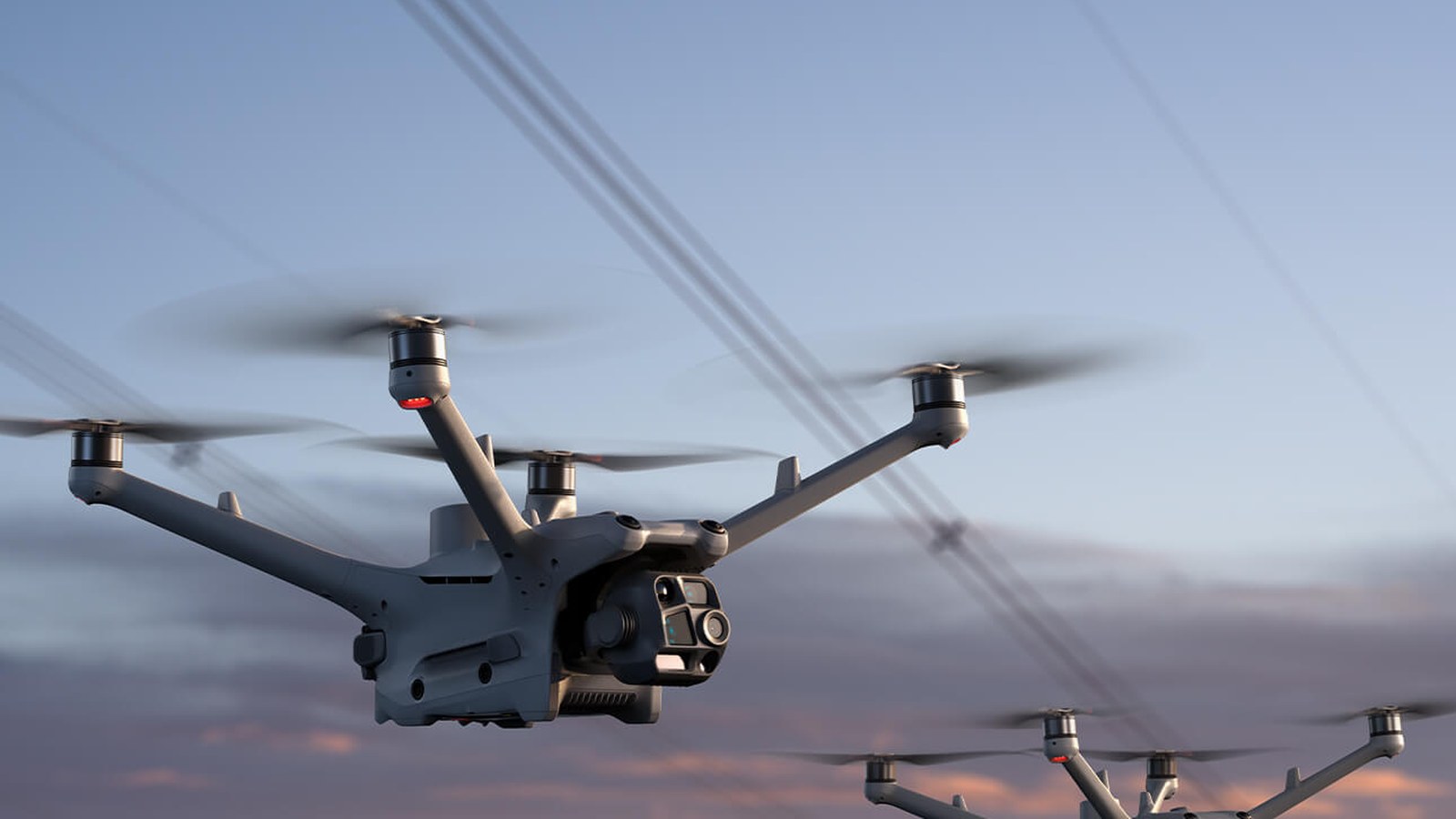
The Matrice 4T is DJI's compact inspection aircraft: an integrated 640 × 512 radiometric thermal camera (±2°C), a wide/medium/tele visual system with 112x hybrid zoom, and a 1,800 m laser rangefinder, in a folding 1.2 kg airframe that flies up to 49 minutes with RTK to 1 cm. It's the aircraft a technician pulls from a truck for a substation thermal round or a pole-top check.
Best for: substation thermal scans, distribution and pole-top inspection, conductor and clearance measurement, storm-damage triage, night patrols. Key limit: 200 g payload, no gimbal port — it can't carry a solar-blind UV corona sensor. That's the Matrice 400's job.
| Matrice 4T — key utility specs | Figure |
|---|---|
| Thermal camera | 640 × 512 radiometric, ±2°C (high gain) |
| Visual / zoom | 48 MP, 112x hybrid zoom |
| Laser rangefinder | 1,800 m |
| RTK accuracy | 1 cm + 1 ppm |
| Max flight time | 49 min |
| Operating temperature | -10°C to 40°C |
| IP rating | No standard rating (see weather note) |
Matrice 400 — The Heavy-Lift Corona & Radiometric Platform
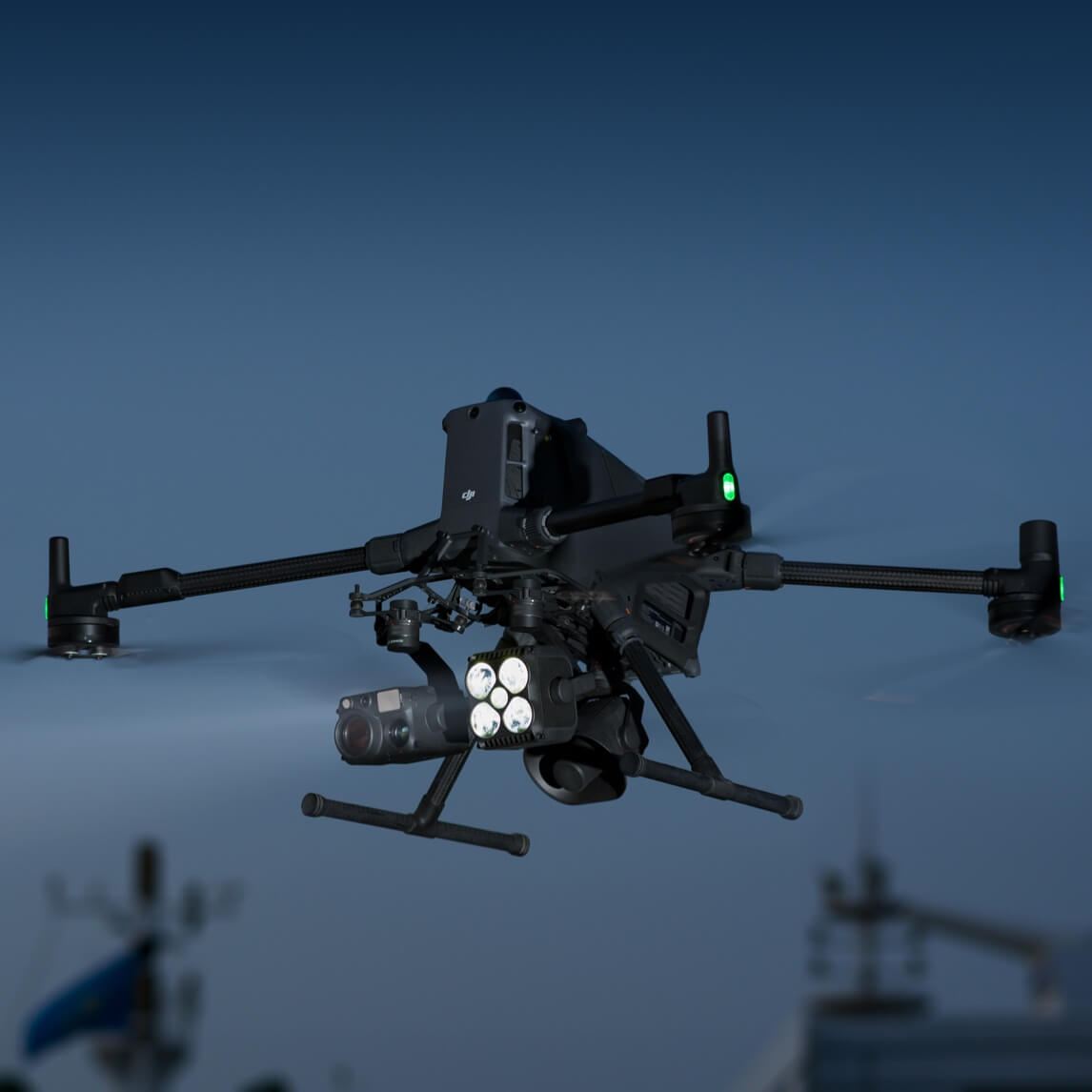
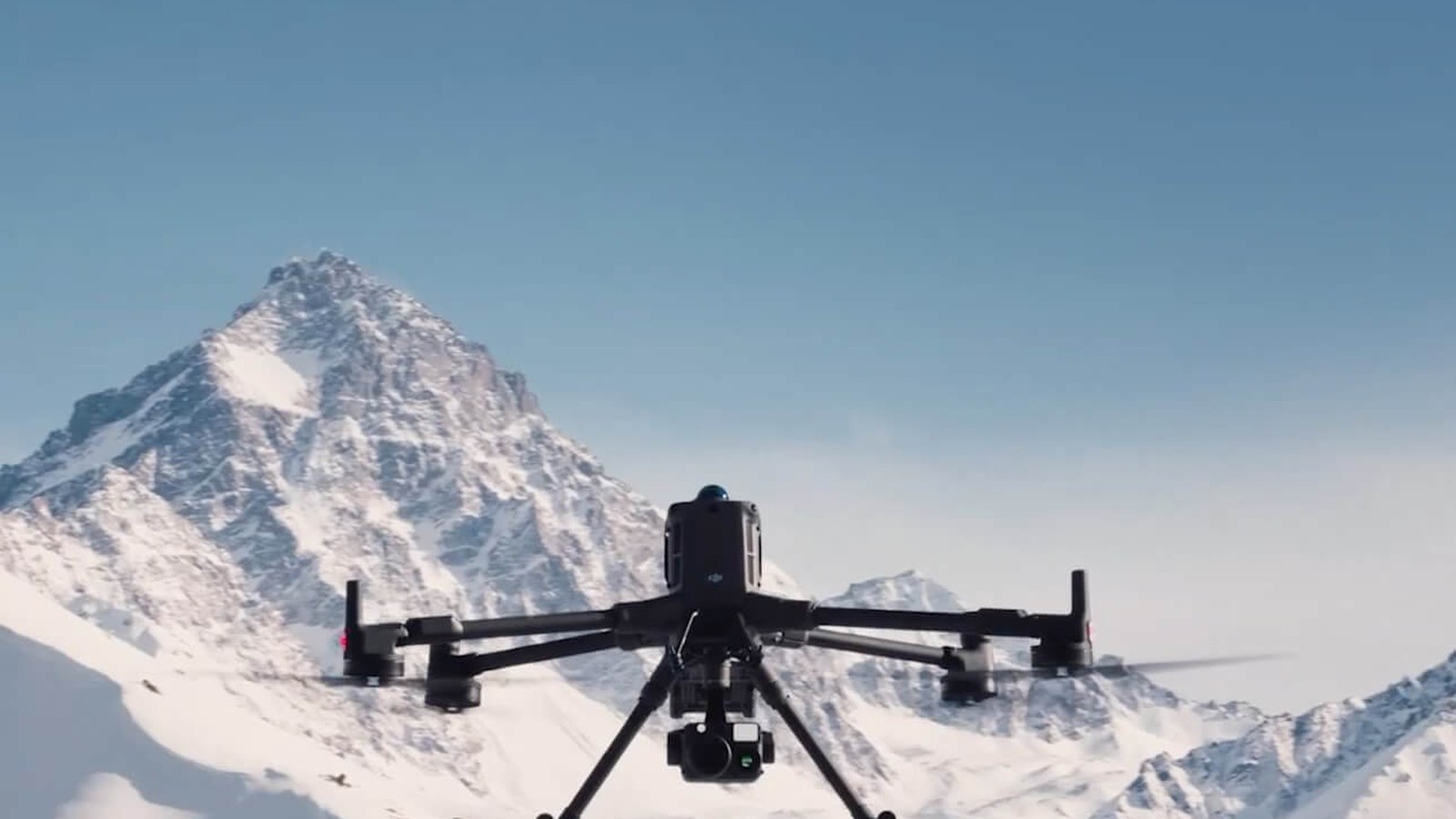
When the job needs a specialist payload — corona/UV detection or high-end radiometric reporting — the Matrice 400 is the heavy-lift airframe: a 6 kg payload capacity, IP55 weather sealing, a -20°C operating floor with self-heating batteries, 59-minute flights, and an RTK module rated to withstand the magnetic interference of transmission infrastructure. It carries the payloads the compact aircraft can't.
Best for: transmission corona / partial-discharge detection, high-end radiometric reporting, transmission tower and conductor inspection, over-people work with a parachute (below). Key strength: it carries the OFIL DayCor solar-blind UV corona payload and the Zenmuse H30T, and its RTK is hardened against interference from metal structures and high-voltage lines.
| Matrice 400 — key utility specs | Figure |
|---|---|
| Max payload | 6 kg (third gimbal connector, sea level) |
| RTK | 1 cm + 1 ppm; hardened vs. HV-line interference |
| Max flight time | 59 min |
| Operating temperature | -20°C to 50°C |
| IP rating | IP55 |
| Sensing | mmWave radar detects a power line at 50 m |
DJI Dock 3 — Automated, Pilot-Free Substation Rounds
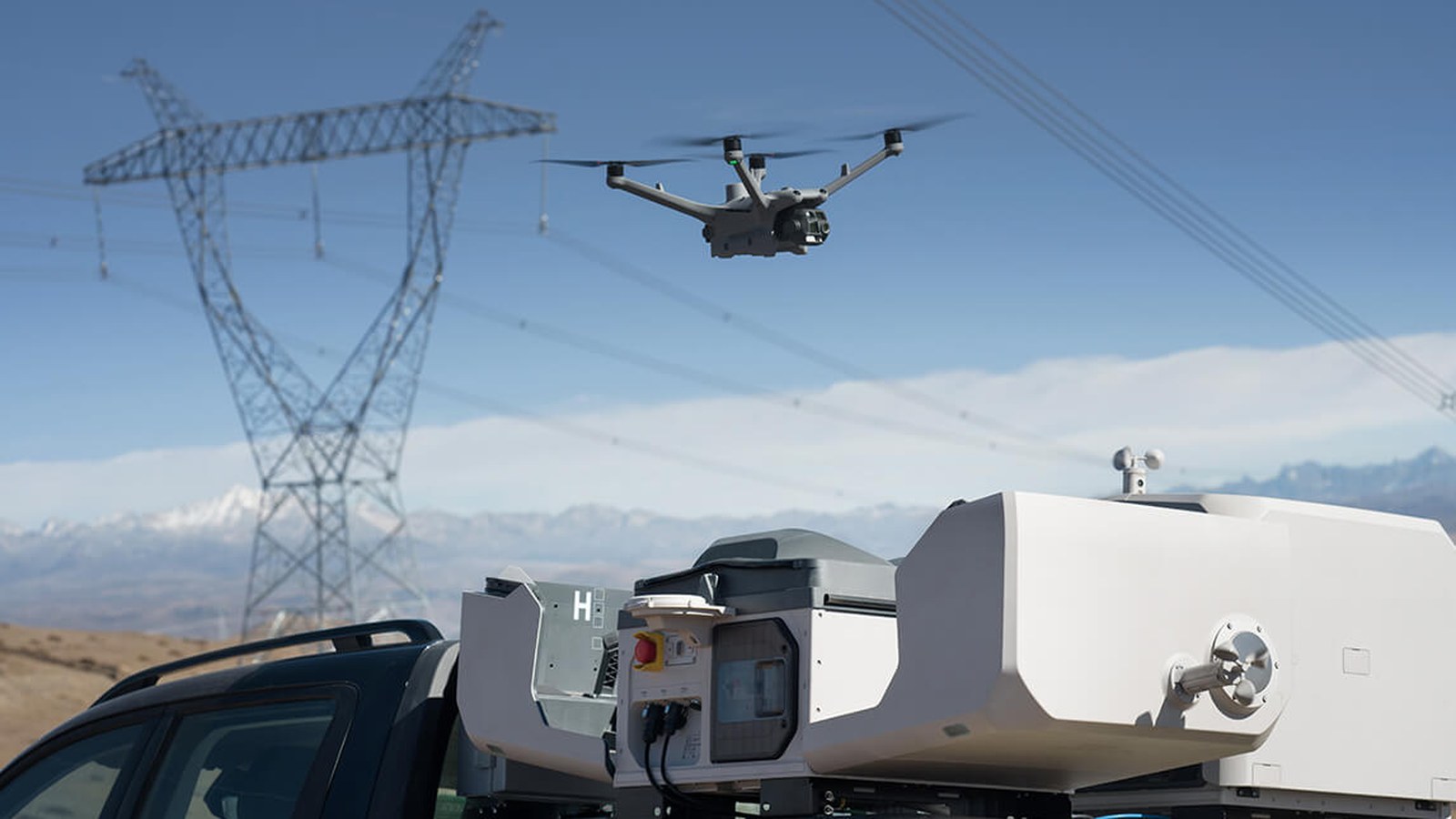
The DJI Dock 3 puts a Matrice 4TD on site permanently and flies the same thermal-and-visual route on a schedule, with no pilot dispatched. It's the answer for unmanned substations and remote assets — recurring thermal trending, distribution patrols, and perimeter security — managed from a control room through DJI FlightHub 2.
Best for: 24/7 autonomous substation thermal rounds, recurring equipment thermal trending, perimeter and security patrols, remote-asset coverage, rapid fault response. Key strength: the weather story — the dock is IP56 and rated to -30°C, the docked Matrice 4TD is IP55 and -20°C with a self-heating battery, making genuinely year-round autonomous inspection realistic in Canada.
| DJI Dock 3 + Matrice 4TD — key specs | Figure |
|---|---|
| Dock ingress protection | IP56 |
| Dock operating temperature | -30°C to 50°C |
| Aircraft (4TD) IP rating | IP55 |
| Aircraft thermal camera | 640 × 512 radiometric |
| Aircraft operating radius | 10 km from dock |
| Deployment | Fixed or vehicle-mounted |
Completing the Program: The Full Utility Ecosystem
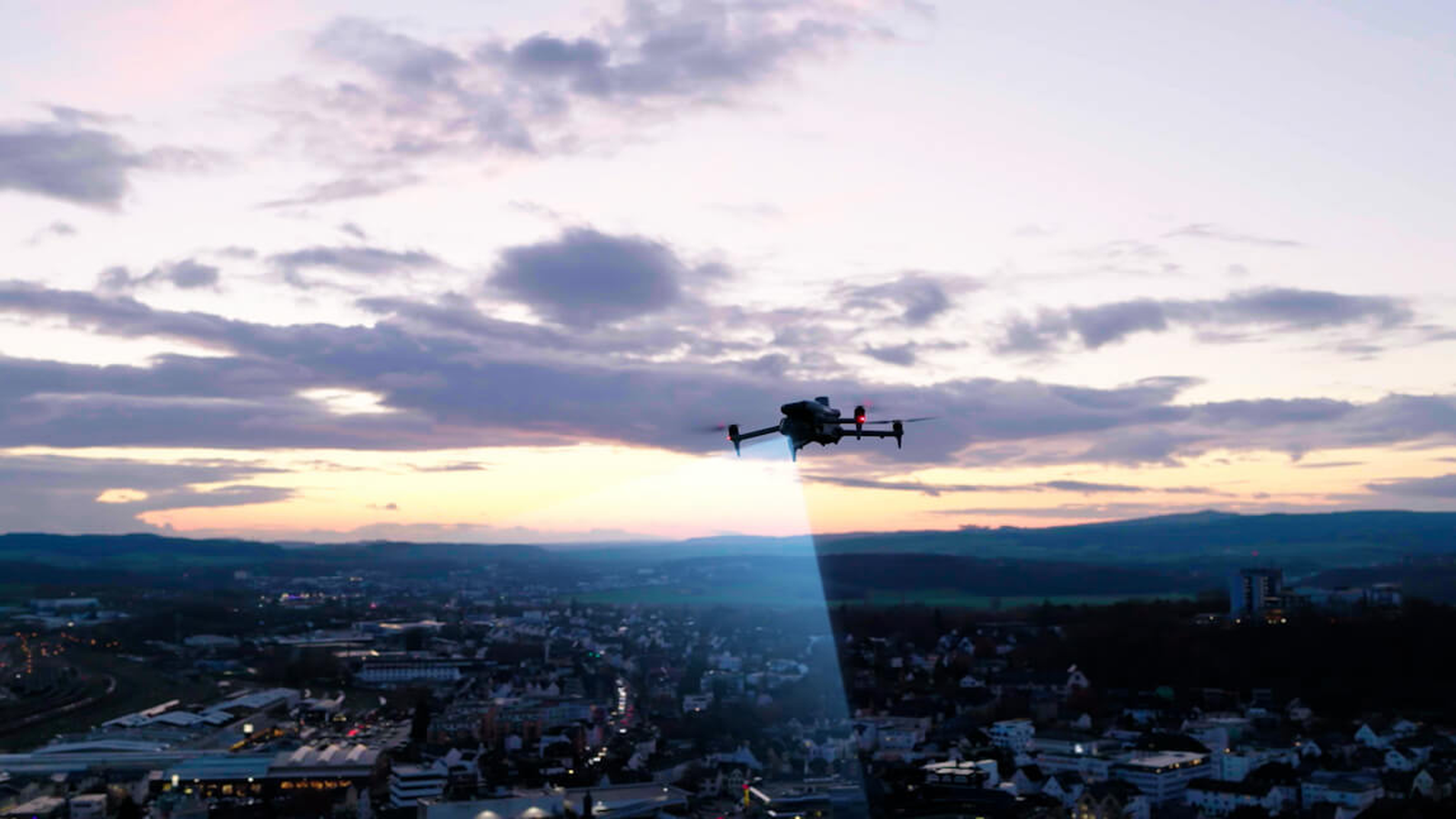
DJI aircraft cover the thermal, visual, and corona-carrying layers, but a complete Canadian utility program spans jobs that need ground robots and corona-specific payloads. Here's how the whole ecosystem we supply fits together.
| Utility job | Platform | Role |
|---|---|---|
| Substation & line thermal / visual (compact foldable transportable drone platform) | Matrice 4T | Fast-deploy thermal + zoom |
| 24/7 automated substation rounds | DJI Dock 3 + Matrice 4TD | Pilot-free scheduled inspection |
| Transmission corona / partial discharge | Matrice 400 + OFIL DayCor | Solar-blind UV corona detection |
| High-end radiometric reporting | Matrice 400 + Zenmuse H30T | Larger multi-spectral payload |
| Autonomous substation ground rounds | Boston Dynamics Spot | At-grade patrol under and between equipment |
| RTK positioning, no network | DJI D-RTK 3 Multifunctional Station | Centimetre reference on remote assets |
Most utility programs run a DJI aircraft (or a dock) for day-to-day thermal inspection and add a heavy-lift platform for corona campaigns and a ground robot for at-grade rounds. We scope the mix against your asset class and inspection cadence.
Energy & Utility Use Cases Across the Lineup
1. Substation Thermal Inspection
Transformers, bushings, and bus connections scanned for hot spots without a lockout. The Matrice 4T handles this on demand; the DJI Dock 3 automates it on a fixed cadence, trending thermal data over time.
2. Transmission Corona & Partial Discharge
Solar-blind UV detection of insulation degradation before it becomes an outage — a Matrice 400 + OFIL DayCor job, beyond the compact aircraft's payload.
3. Distribution & Line Patrols
Pole-top hardware, insulators, and connections read from the ground at 112x zoom. The Matrice 4T patrols on demand; a docked 4TD extends automated coverage along nearby lines.
4. Perimeter & Security
Substation yards and critical-infrastructure perimeters patrolled day and night. The DJI Dock 3 runs scheduled sweeps with the 4TD's night imaging; a 4T used as a compact foldable transportable drone platform covers ad-hoc checks.
5. Storm & Outage Response
Fast damage triage across a service area, and rapid fault response at unmanned sites. The 4T deploys from a truck in minutes; a Dock 3 launches on-demand from the control room.
6. Wind & Renewables
Blade and site inspection for wind farms — thermal and visual with the 4T, mapping with a Matrice 4E, and heavy or high-resolution payloads on the Matrice 400.
Parachutes & Over-People Flight
Flying over people — common where distribution corridors run through neighbourhoods — is an advanced operation under Transport Canada's CARs Part IX, and a deployable parachute is the recognized ground-risk mitigation. The right system is platform-specific and doesn't transfer between airframes:
| Platform | Parachute | Notes |
|---|---|---|
| Matrice 400 | DJI AP100 Parachute | Purpose-built for the M400; Canadian over-people certification still in progress |
| Matrice 4T / 4TD | AVSS Parachute Recovery System for the Matrice 4 Series | 149 g, <0.5 s deploy, motor cut-off, ~3.8 m/s descent, ASTM F3322 / EASA MOC docs |
For the Matrice 4 Series (4T and the docked 4TD), the AVSS system is the recognized mitigation; for the heavy-lift Matrice 400, it's the DJI AP100. Parachute integration and its Canadian regulatory standing are configuration-specific, so we scope the parachute and the over-people compliance case together with the platform — essential for inspecting distribution assets in populated areas.
IP Ratings & Canadian Weather
| Platform | IP rating | Operating temp | All-weather? |
|---|---|---|---|
| Matrice 4T (compact foldable transportable drone platform) | No standard rating | -10°C to 40°C | Fair-weather; no rain |
| Matrice 400 | IP55 | -20°C to 50°C | Yes; dust & rain, self-heating battery |
| DJI Dock 3 | IP56 | -30°C to 50°C | Yes; sealed, weather sensors |
| Matrice 4TD (docked) | IP55 | -20°C to 50°C | Yes; self-heating battery |
The takeaway for a Canadian utility: the standard Matrice 4T compact foldable transportable drone platform has no IP rating and shouldn't fly in rain, so for all-weather patrols or year-round automated rounds the Matrice 400 (IP55) or a Dock 3 deployment (IP56 dock, IP55 aircraft, -30°C) is the platform. Match the ingress rating to your operating environment during scoping.
Compliance & Operations
Flying near energized assets and over people is an advanced operation under CARs Part IX, requiring a pilot certified for Advanced Operations, NAV CANADA authorization in controlled airspace, and a valid RPAS Safety Assurance declaration. We support Transport Canada Advanced Operations, BVLOS pathways, airspace authorization, and SFOC applications — and for utilities that want inspection delivered as data, our Remote Operations Center runs recurring rounds as a managed service.
Common Questions
Which DJI drone is best for utility inspection?
There's no single answer — the Matrice 4T as a compact foldable transportable drone platform for thermal and visual inspection, the Matrice 400 for corona and heavy radiometric payloads, and the DJI Dock 3 for automated recurring rounds. Most programs combine them.
Can a DJI drone do powerline corona inspection?
Not on its own camera — corona detection needs a solar-blind UV payload like the OFIL DayCor, which mounts on the heavy-lift Matrice 400. The compact Matrice 4T handles thermal and visual inspection.
What's the best DJI drone for substation thermal scans?
The Matrice 4T for on-demand scans, or a DJI Dock 3 with a Matrice 4TD for automated recurring thermal rounds. Both carry a 640 × 512 radiometric thermal camera.
Which DJI utility drones work in a Canadian winter?
The Matrice 400 (IP55, -20°C) and the Dock 3 with Matrice 4TD (dock IP56 to -30°C, aircraft IP55 to -20°C). The standard Matrice 4T compact foldable transportable drone platform is rated only to -10°C with no IP rating.
Can a drone replace manual substation walks?
For scheduled thermal and visual rounds, aerial coverage plus an autonomous ground robot like Boston Dynamics Spot covers most assets. Most programs combine aerial and ground.
Can I fly a DJI drone over people with a parachute?
Over-people flight is an advanced operation. The Matrice 400 uses the DJI AP100; the Matrice 4 Series uses the AVSS system. Both are ground-risk mitigations, and we scope the Transport Canada compliance case with you.
The Bottom Line for Canadian Utilities
DJI's utility lineup isn't one drone — it's a compact foldable transportable drone platform for thermal inspection (Matrice 4T), a heavy-lift corona and radiometric platform (Matrice 400), and an autonomous dock (Dock 3 + Matrice 4TD), each matched to a different part of the inspection program. Around them, corona payloads and ground robots complete a Canadian utility operation. The right build depends on your asset class, your cadence, and your weather — and matching the IP rating and payload to the job is what separates a program that runs year-round from one that doesn't.
If you're scoping a utility inspection program, request a proposal. Share your asset class — transmission, distribution, substation, or renewables — and we'll scope the right combination of aircraft, corona and thermal payloads, ground robots, parachute, and support.
Matrice 4T vs Matrice 400 vs DJI Dock 3: Which for Your Utility Program?
The three DJI utility platforms overlap on the surface but do genuinely different jobs. Here's the side-by-side.
| Feature | Matrice 4T | Matrice 400 | DJI Dock 3 + Matrice 4TD |
|---|---|---|---|
| Class | Compact inspection quad | Heavy-lift quad | Autonomous dock system |
| Payload | 200 g (integrated sensors) | 6 kg (gimbal payloads) | 200 g (integrated sensors) |
| Thermal camera | 640 × 512 (integrated) | Via payload (e.g. H30T) | 640 × 512 (integrated) |
| Carries corona/UV payload? | No | Yes (OFIL DayCor) | No |
| Laser rangefinder | 1,800 m | Via payload | 1,800 m |
| RTK accuracy | 1 cm + 1 ppm | 1 cm + 1 ppm | 1 cm + 1 ppm |
| Max flight time | 49 min | 59 min | 54 min |
| IP rating | No standard rating | IP55 | IP55 aircraft / IP56 dock |
| Operating temp | -10°C to 40°C | -20°C to 50°C | -20°C aircraft / -30°C dock |
| Parachute | AVSS (Matrice 4 Series) | DJI AP100 | AVSS (configuration-specific) |
| Deployment | Compact foldable transportable drone platform | Crew-flown | Fixed or vehicle-mounted dock |
| Autonomy | Piloted | Piloted | Scheduled, pilot-free |
| Best for | Compact foldable transportable drone platform thermal inspection | Corona, heavy radiometric | 24/7 recurring rounds |
Which One for Your Program?
Choose the Matrice 4T if your core need is a compact foldable transportable drone platform for thermal and visual inspection — substation scans, line patrols, and storm response a technician flies on demand.
Choose the Matrice 400 if you need transmission corona detection with the OFIL DayCor or high-end radiometric reporting with the Zenmuse H30T, plus IP55 all-weather capability and the DJI AP100 Parachute option for over-people work.
Choose a DJI Dock 3 with the Matrice 4TD if your need is recurring, pilot-free coverage of substations and remote assets — 24/7 thermal rounds, perimeter security, and rapid fault response run from a control room in any weather.
And add the ground platform — Boston Dynamics Spot for at-grade autonomous rounds under and between substation equipment — for coverage the aerial platforms can't reach. Most utility programs combine a compact foldable transportable 4T, a docked 4TD, and an M400 for corona.
Not sure which fits? Talk to us — tell us your asset class and inspection cadence, and we'll scope the right combination rather than sell you one aircraft for every job.
Sources
- DJI Matrice 400, Matrice 4 Series, and Dock 3 specifications: enterprise.dji.com
- DJI Matrice 400, Matrice 4 Series, and Matrice 4D / Dock 3 User Manuals
- Transport Canada, Drone operation categories and pilot certificates: tc.canada.ca
Disclaimer — Remote Robotic publishes content based on the latest available information from our vendors and partners. Specifications, pricing, certifications, and feature availability can change without notice, and some details may be incorrect or subject to verification. Always confirm critical specifications with our team before making a purchasing or operational decision.
Shop the story
Related products in our catalog
Every product below is stocked and supported by Remote Robotic in Canada.
- DJI Matrice 4T
DJI Matrice 4T
Multi-sensor M4 Series with thermal + NIR + laser rangefinder for inspection & public safety.
View product → - DJI Matrice 4TD
DJI Matrice 4TD
Dock-native thermal M4TD with NIR aux light — night-ops DFR and thermal patrol.
View product → - DJI Matrice 400
DJI Matrice 400
Flagship enterprise M400 airframe — 59 min flight, 6 kg payload, multi-sensor ready.
View product → - DJI Dock 3
DJI Dock 3
Automated dock for Matrice 4D and Matrice 4TD remote inspection programs.
View product → - DJI Zenmuse H30T
DJI Zenmuse H30T
Wide + 34× zoom + thermal (1280×1024) + laser rangefinder + NIR — the flagship M400 payload.
View product → - DJI AP100 Parachute
DJI AP100 Parachute
Certified recovery parachute for the M400 — the enabler for flight over people workflows.
View product → - AVSS Parachute Recovery System for Matrice 4 Series
AVSS Parachute Recovery System for Matrice 4 Series
Parachute recovery system for Matrice 4 Series flight-over-people planning.
View product → - D-RTK 3 Multifunctional Station
D-RTK 3 Multifunctional Station
Cm-level GNSS base / rover / relay — foundation of any M400 survey workflow.
View product →